This complete guide for international buyers walks through the full journey: define specs, source and vet suppliers, negotiate terms, ship freight, clear customs, inspect quality, and manage after-sales support. Contractors, developers, and project buyers benefit most. The advice suits first-time importers and teams scaling from trial orders. Importing products from China rewards preparation, not luck.
Key Takeaways
- Importing HVAC systems from China can cut equipment costs by 30–50% compared to local sourcing.
- Define exact specifications like voltage, refrigerant, and certifications before contacting suppliers.
- Vet suppliers carefully: check business licenses, order samples, and audit factories for large orders.
- Calculate total landed cost, including freight, duties, and tariffs, not just the unit price.
- Schedule a pre-shipment inspection to verify quality and quantity before goods leave China.
Why Import HVAC Systems from China
Cost Savings and Customization
The strongest reason is cost. Contractors who import hvac systems from China can cut equipment costs by 30–50% versus local sourcing. That margin changes a project bid.
The savings do not force buyers to accept standard products. Chinese factories offer broad customization. Buyers can order hvac equipment with specific capacity, voltage, refrigerant, and control systems. A 50 Hz market can receive frequency-matched compressors. A developer can apply a private label to each unit. These options come from original equipment manufacturers and original design manufacturers.
Customization demands precise documentation. Every deviation — voltage, refrigerant type, efficiency rating, branding — must be defined in the contract, because a spec that lives only in an email thread will resurface as a costly dispute.
Buyers should compare quotes on a landed-cost basis, not factory-gate price. Freight, duty, and certification add to the total. A low unit price can disappear after shipping and tariff costs. The 30–50% benchmark applies to equipment cost, so include every fee.
One Factory, Whole-Project Supply
Ordering multiple categories from one factory also simplifies spare parts stocking. Standard components are easier to restock when they come from one production line. Project teams can reduce downtime risk while equipment remains under warranty.
Scale also supports pricing stability. Large factories benefit from lower material costs. They can maintain consistent quality across massive production runs. That combination creates a strong case for long-term supplier relationships.
Selecting the right partner matters more than selecting the cheapest quote. Specialized manufacturers understand performance requirements. They also understand certification rules in your destination country. General trading companies rarely provide that level of support.
HVAC Product Categories and Specs
Splits, VRF, Rooftops, and Packaged Units
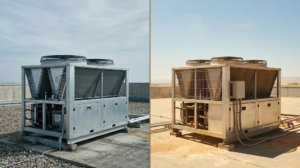
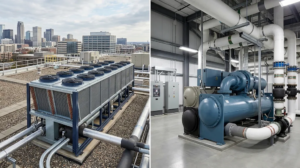
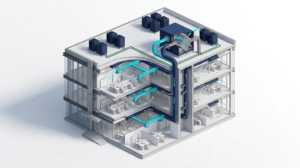
China supplies every major category of hvac equipment. Split systems fit apartments and small offices. VRF systems serve mid-size commercial buildings with many zones. Rooftop units and packaged units handle large projects where factory-assembled equipment saves installation time. Chillers, air handling units, fan coils, and heat pumps complete the range.
Each category carries its own specification logic. A contractor buying splits focuses on room-by-room load matching. A developer specifying VRF cares about zone diversity and pipe runs. Rooftop and packaged units demand attention to airflow, external static pressure, duct length, bends, diffuser losses, and return-air conditions. Buyers should request a written selection calculation rather than accept catalogue rated capacity. Site-specific conditions matter: highest expected ambient temperature, indoor temperature target, building dimensions, construction materials, occupancy, heat-generating loads, door-opening frequency, ducting, and power supply.
Matching Voltage, Frequency, and Refrigerant
A successful import starts with exact specs. Buyers must define capacity, refrigerant type, voltage, efficiency ratings, and destination-country certifications before contacting any factory. The table below summarizes the core specification areas.
| Specification area | What contractors must define |
|---|---|
| Refrigerant | Confirm the type is permitted locally, such as R32, R410A, R454B, or R290. The choice affects safety design, technician training, shipping classification, charge limits, component selection, and local service capability. |
| Electrical system | Define voltage, frequency, phase, and tolerance. Specify plug, breaker, cable, control panel, IP rating, BMS protocol, controller language, labels, manuals, and emergency-stop logic. |
| Cooling and heating capacity | Provide site conditions and request a written selection calculation. Verify heat-pump operation through an approved pre-production sample covering performance, noise, airflow, electrical configuration, labels, manuals, and packaging. |
| Efficiency ratings | Request integrated part-load value data. For chillers, ask for part-load efficiency, operating map, acoustic information, and fault-response procedures. |
Refrigerant type and pressure vessel status affect shipping and import rules. Some refrigerants face charge limits or handling requirements during transport. Pressure vessels may need certification before carriers accept them. Buyers should confirm these rules early, because a refrigerant choice that works technically can still block a shipment.
HVAC Equipment Procurement from China: Sourcing Channels
B2B Platforms, Canton Fair, and Yiwu Market
Online B2B platforms are the fastest entry point for sourcing HVAC equipment from China. Alibaba lists thousands of factories and trading companies. The 1688 platform serves the domestic Chinese market and often shows lower prices, though it requires a local agent to order. Buyers should filter for verified suppliers, gold status, and transaction history. These signals filter out the riskiest listings.
Trade shows add a layer that platforms cannot match. The Canton Fair in Guangzhou runs twice a year and hosts major hvac equipment suppliers. Yiwu Market focuses on smaller goods, yet some vendors carry components and accessories. Face-to-face meetings let buyers inspect samples, compare build quality, and negotiate directly. For a serious order, one show visit builds more trust than months of messaging.
Trade Data Tools and Sourcing Agents
Trade data tools reveal which factories actually ship. ImportYeti and similar platforms show US customs records, including supplier names, shipment volumes, and buyer histories. This data helps buyers shortlist factories with proven export experience. A supplier with steady shipments to your region is a safer bet than an unknown vendor.
Sourcing agents manage the parts that trip up new importers. They verify business licenses, arrange factory audits, negotiate in Mandarin, and coordinate inspections. Good agents also manage the logistics, from sample orders to container loading. The right agent turns importing into a repeatable process rather than a one-time gamble.
Trade data and agents work best together. Data narrows the field to real manufacturers; agents confirm those factories can meet your specs. Together they lower the chance of a failed order — you see the full picture before any money changes hands. and lowers the chance of a failed order — you see the full picture before any money changes hands.
Vetting Suppliers and Verifying Factories
Business Licenses and Third-Party Audits
Supplier vetting starts with documents, not promises. Request the business license and verify the registered name, unified social credit code, active legal status, and business scope. The scope must cover manufacturing the exact product you intend to buy. A trading company with a license for general merchandise cannot prove production capability.
Payment identity is the next checkpoint. The bank account name must match the license name. A personal account or a third-party account is a stop sign. This single check blocks most advance-fee fraud.
Documents alone prove little, so confirm the factory exists through a live video walkthrough of the production line and cross-check the address against satellite maps and export records. For orders of $50k or more, commission a third-party factory audit before paying any deposit. Independent agencies such as SGS, Bureau Veritas, or TÜV verify production capacity, quality systems, and working conditions. Schedule a full audit before the first production order, then an annual surveillance audit. After any quality incident, conduct a short-notice audit within 60 days. Document every audit with a dated report and corrective action requests.
Certification checks deserve the same rigor. Verify ISO 9001 by confirming the legal entity name, production scope, and expiry date through the issuing body or accredited databases such as IAF CertSearch. Require ISO 14001 or ISO 45001 where relevant, and confirm each certificate links to the actual manufacturing entity. For CE or RoHS, confirm the notified body, test reports, and the specific product family. Reject generic certificates that do not match the real product configuration. Any mismatch between the certificate entity and the factory is a red flag.
Sample Orders and On-Site Inspections
Samples reveal what brochures hide. Order a paid sample and test it under real operating conditions before considering the factory further. This step answers the central question of how to choose the right hvac supplier in china: capability, not price, decides the shortlist.
A staged sample process controls risk across hvac equipment procurement. The table below summarizes each stage.
| Stage | What to verify |
|---|---|
| Documentation sample | Model list, specification, BOM, drawings, labels, manuals, certificates |
| Engineering sample | Function, components, workmanship, dimensions, controls, noise, drainage |
| Compliance sample | Testing at an accredited laboratory with the correct configuration |
| Golden sample | Sealed unit, packaging, firmware, and signed approval record |
| Pilot production | Yield, test failures, cycle time, traceability before full release |
On-site inspections confirm the factory, not just the sales office. Walk the sheet-metal workshop, assembly lines, brazing stations, leak-testing equipment, and final-run testing stations. Check compressor, coil, and motor inventory. Review serial-number tracking and spare-parts storage. Ask for references from established international clients and their delivery performance.
Red flags appear early. Vague specifications, refusal to allow audits, and unusually low quotes signal danger. A business license alone never justifies a bulk order. Combine it with a sample, a factory check, and a pre-shipment inspection. This discipline is what keeps importing profitable — it protects every dollar you send.
HVAC Procurement from China: Negotiation Essentials
Negotiation turns quotes into a binding contract. Once quotes arrive, your focus shifts from finding suppliers to managing payment risk and legal protection.
Price, MOQ, Payment Terms, and Incoterms
Price negotiation starts with minimum order quantities. Supplier quotes assume a specific MOQ. Large MOQs lower the unit price but tie up storage space. Confirm the MOQ before requesting discounts. A price for 50 units rarely applies to a 10-unit order.
Payment terms define financial risk. Telegraphic transfer (T/T) remains common. Most hvac procurement from China starts with a 30% deposit, then 70% before shipment. That structure exposes the buyer. A letter of credit (L/C) protects funds because banks verify documents before payment. L/C costs more and requires precise paperwork. Trade assurance adds a mediation layer. New importers should avoid full prepayment.
Incoterms determine where cost and risk transfer. FOB places risk at the loading port. The buyer owns freight and customs clearance. CIF includes insurance and freight to the destination port. DDP makes the supplier responsible for delivery, duty, and taxes. Use FOB with a trusted freight forwarder. Choose DDP for small, urgent orders.
Certifications, Lead Times, and Warranty
Certifications belong in the contract, not in email promises. US-bound equipment must meet UL/ETL safety listing, DOE efficiency rules, and EPA refrigerant requirements. European-bound units need CE, RoHS, and F-Gas compliance. Request test reports before production.
Lead times affect project schedules. Standard split systems ship two to four weeks after deposit. Custom VRF or rooftop units often need eight to twelve weeks. Put the date in writing and include a penalty clause for late delivery.
Warranty clauses define after-sales support. Most hvac equipment carries a one-year parts warranty. Negotiate longer coverage for compressors. Define the claim process: notice window, return authorization, replacement shipment, and freight responsibility. Clarify whether labor is covered. Keep serial numbers for each unit.
These contract terms are your safety net: documented requirements prevent disputes far more reliably than good relationships do.
Logistics Strategy for HVAC Shipments
FCL, LCL, Air, and Rail Freight
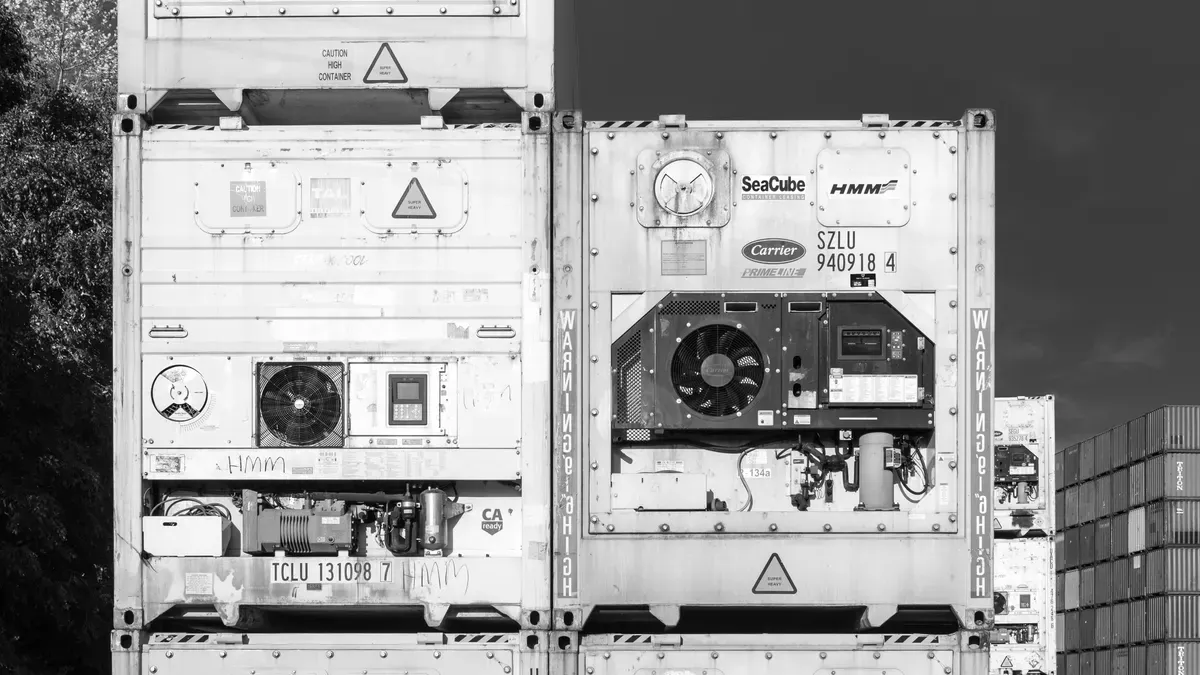
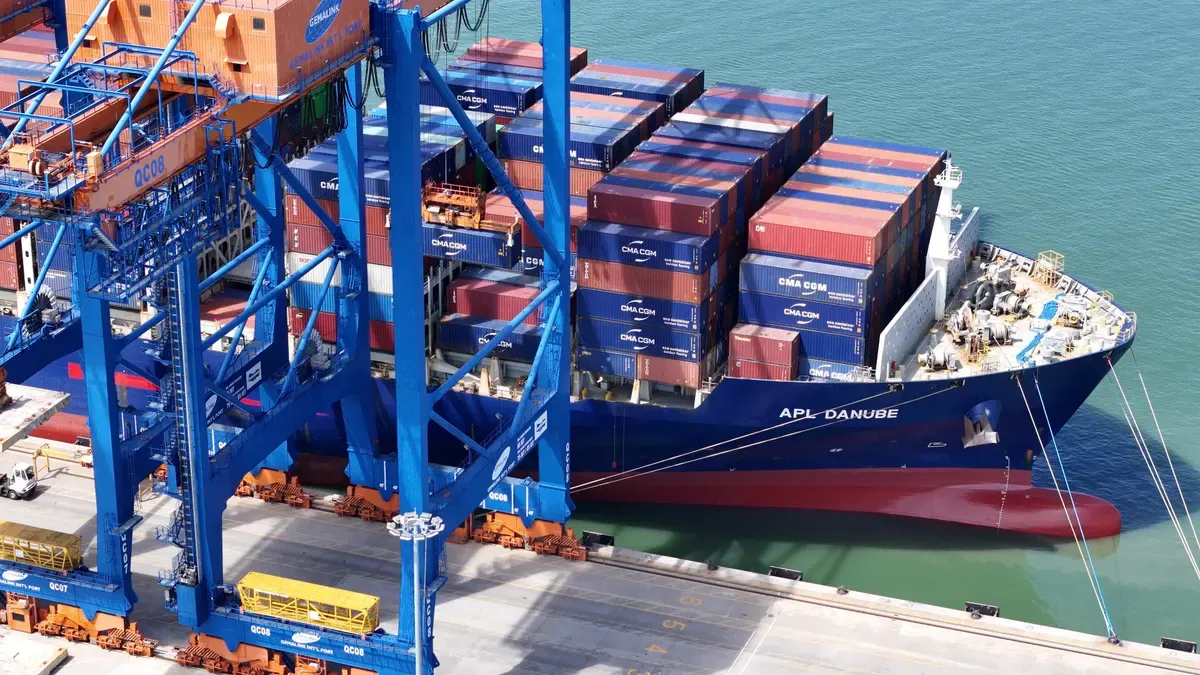
Freight mode selection shapes both budget and schedule. Full container load (FCL) suits large HVAC systems. A dedicated container protects equipment from handling damage and usually lowers the per-unit cost of shipping air conditioners at volume. Less than container load (LCL) works for smaller orders, yet shared containers invite delays and extra handling. The cost to ship air conditioners by LCL rises when cargo volume approaches a full container, so compare both options at that threshold.
Air freight can move urgent orders in days rather than weeks, but at several times the ocean rate — so reserve it for critical spares and pilot units. Rail freight offers a middle path for inland destinations, though transit times and route availability vary by region.
Seasonal congestion affects every mode: peak seasons tighten container space and raise rates, and heavy compressors and bulky air handlers push costs up further. Book early and confirm space before production finishes.
Calculating Total Landed Cost
Landed cost extends far beyond the unit price. The table below breaks down each layer for HVAC imports.
| Cost Component | What It Covers | Typical Rate |
|---|---|---|
| Unit FOB cost | Base ex-works equipment price | Varies by SKU |
| Freight | Ocean or air transport to destination port | Varies |
| Insurance | Cargo coverage in transit | Varies |
| Section 232 duty | Steel, aluminum, copper content | Metal tariffs changed repeatedly in 2025–2026 — confirm current rates with your broker |
| Section 301 duty | China-origin goods | 7.5%–25%+, varies by HTS code — verify the current rate |
| Brokerage | Customs entry filing | Varies |
| Inland delivery | Port to project site | Varies |
The Section 122 surcharge expired in July 2026 and is no longer part of the landed-cost stack — but successor measures could appear, so re-check before each shipment.
Section 301 applies on top of most other duties, but goods already covered by Section 232 measures are generally not stacked with across-the-board surcharges. The interaction depends on your specific HTS code — misreading the stack is the single most common landed-cost error. Note also that the Section 122 surcharge expired in July 2026; treat any successor measure the same way: temporary until proven permanent.
Tariffs cannot be modeled on an air conditioner as one line item. Each major assembly carries its own material content, country of origin, and governing HTS code. Compressors and coils hold heavy steel and copper exposure. Cabinets and line sets add steel and copper hits. Control boards carry Section 301 exposure by origin. The refrigerant charge receives separate duty treatment. Decompose the unit before modeling air conditioner shipments. This discipline keeps the cost of shipping air conditioners predictable and protects project margins.
Customs Clearance and Compliance
Import customs clearance turns an order into a legal delivery. Direct importing usually needs no special import license. Importers must complete local business registration and follow product-specific rules. A classification error can trigger penalties or shipment holds. Importing products from china rewards precise documentation at this stage.
HS Codes, Duties, VAT, and EORI
HS codes define duty rates. Air conditioners, heat pumps, chillers, and air handling units each carry separate codes. An incorrect code leads to overpayment or customs delays. Buyers must review updated duty rates and Section 301 tariffs for 2026 US imports. These tariffs can significantly raise total cost.
European buyers also need an EORI number and must plan for import VAT — both covered in the Europe section below.
Certifications, Energy Labels, and Refrigerant Rules
Each shipment requires a standard document set. Prepare the commercial invoice, packing list, bill of lading, and certificate of origin before the vessel departs. The packing list must describe every item in every box, match the commercial invoice exactly, and carry the HS code classification — a mismatch invites inspection delays. Keep one copy inside the shipment for inspectors.
HVAC equipment imported into the U.S. must comply with energy efficiency standards, environmental regulations, and safety certifications, which makes documentation and compliance a critical part of the shipping process.
The EPA regulates refrigerants. Some hvac equipment requires EPA compliance documents. Product testing requirements depend on the equipment category. Energy efficiency certifications may apply depending on product type. Safety approvals also vary depending on product type. Buyers must identify which rules apply to each model.
Compliance areas include:
- EPA regulations
- Energy efficiency standards
- Electrical and safety requirements
- Accurate customs documentation
Failure to meet these requirements can lead to shipment holds, inspections, or rejection. A certificate of origin supports duty claims. The bill of lading proves ownership during transit. Tight documentation keeps hvac equipment moving through customs without costly delays.
Importing Air Conditioners from China to Europe
EU-Specific Certifications and F-Gas Rules
European importers face a distinct compliance landscape. Every unit must carry the right marks before it clears customs. A CE declaration is a legal manufacturer statement that the product meets all applicable EU health, safety, and environmental rules. It is not a quality seal. The Low Voltage Directive covers electrical safety for equipment operating at 50–1000V AC or 75–1500V DC. The EMC Directive ensures compressors, inverters, and fans do not emit excessive interference or malfunction in their expected environment. RoHS restricts ten hazardous substances in electrical equipment. The ErP framework and EU energy label mandate minimum seasonal efficiency and sound-power limits. WEEE adds producer responsibility for collection and treatment of waste units.
F-Gas rules deserve separate attention. The regulation progressively cuts market volume of high-GWP refrigerants and sets a GWP-based ban timetable for new equipment. R290 carries a GWP below 3 and is largely unaffected. However, R290 is A3 flammable. Installation must follow EN 60335-2-40 for charge limits and EN 378 for safety requirements. Only F-Gas-certified technicians may handle these units. An EU F-Gas check confirms the refrigerant type, charge, and handling route before shipment. Supplementary standards include EN 60335-2-40 for electrical safety and EN 14511 or EN 14825 for performance.
| EU Requirement | What It Mandates |
|---|---|
| CE Marking | Manufacturer declaration of conformity with all applicable EU rules |
| LVD | Electrical safety against shock, overheating, and fire |
| EMC Directive | Limits electromagnetic interference and ensures immunity |
| RoHS | Restricts ten hazardous substances in electrical equipment |
| ErP / EU Energy Label | Minimum seasonal efficiency and sound-power limits |
| WEEE | Producer-funded collection and treatment of waste equipment |
| F-Gas Regulation | Cuts high-GWP refrigerant volume; sets ban timetable |
| R290 Standards | EN 60335-2-40 charge limits and EN 378 safety rules |
VAT, EORI, and Customs Brokers
Importing air conditioners from China to Europe requires an EORI number. This identifier tracks goods through EU customs. Registration takes several days, so start early. VAT rules vary by member state. Most countries charge VAT at the point of import, though some defer it through postponed accounting. European importers should confirm the rate and payment method for their destination.
Licensed customs brokers handle EU customs clearance requirements. They classify goods under the correct HS code, file entries, and manage duty payments. Freight forwarders coordinate transport and often partner with brokers. A reliable broker reduces delay risk and keeps documentation aligned. Importing air conditioners without a broker invites errors. The right partner ensures smooth import customs clearance and protects project timelines.
Packaging, QC, and Pre-Shipment Inspection
Preventing Damage on Large Units
Large hvac equipment faces serious risks during ocean transit. Vibration, stacking loads, and multiple handling points can dent panels, break grilles, and destabilize compressors. Proper packaging prevents these losses before they occur.
Moisture-proof plastic film wrapping protects against corrosion during long sea voyages. Foam padding around the body, control panel, and compressor area absorbs shock and vibration. Wooden crates with reinforced steel corners and internal bracing withstand maritime conditions. Wood packaging must meet ISPM 15 requirements through heat treatment or fumigation, with the IPPC mark showing country code, treatment facility number, and method. A fumigation certificate avoids quarantine delays.
LCL shipments demand stronger packaging because cargo passes through consolidation warehouses and multiple handling points. High-value models should be palletized for safer transit. Verify carton strength and model-specific packaging before shipping air conditioners. Weak cartons lead to dented panels and broken components.
Weight limits matter for container planning. A 20-ft container holds approximately 17.3 tons of cargo. A 40-ft high-cube holds about 19.5 tons including packaging. Exceeding these limits triggers overweight fines or offloading at port. Mark each crate with handling instructions, gross and net weight, dimensions, and prominent warnings such as Heavy Load – Use Forklift Only.
Confirming Quantity and Functionality
Third-party pre-shipment inspections verify quantity, quality, functionality, and packaging before goods leave China. The golden inspection window requires 100% production completion, at least 80% of finished goods packed into final cartons, and completion 7–10 calendar days before the vessel cut-off date. Payment milestones typically release the 30–70% T/T balance only after a passing report.
Inspectors use ANSI/ASQ Z1.4 to determine sample sizes. For a lot of 1,200 units at Level II, the sample is 80 pieces drawn from at least 10–12 cartons across different pallets. The inspector pulls cartons independently, never the factory. Functional tests include power on/off, software boot, and barcode scanning. Hi-pot testing applies 1,500V to 3,750V AC between plug pins and accessible metal housing, with leakage current below 5mA and zero arcing. Carton drop tests follow ISTA 1A, dropping master cartons from 76cm across one corner, three edges, and six faces.
The final report delivers a PASS, PENDING, or FAIL verdict. It itemizes defects against AQL limits: Critical at 0, Major at 2.5, and Minor at 4.0. Over 50 high-resolution photos document product condition, labels, and every defect with measurement scales. This discipline protects every air conditioner shipment and keeps importing air conditioners predictable.
Final Delivery, Warehousing, and After-Sales
Last-Mile Delivery and Installation Planning
Port handling marks the first step after customs release. A customs broker coordinates container pickup, and a trucking company moves the freight to a warehouse or directly to the project site. For large developments, staging a nearby warehouse allows phased delivery as installation crews progress through the building. This approach reduces on-site congestion and protects hvac equipment from weather and theft before installation begins.
Installation planning should start before the shipment arrives. Contractors must confirm that technicians understand the specific refrigerant, control system, and commissioning requirements of the imported units. Training on new refrigerants and proper commissioning procedures prevents callbacks and protects warranty coverage. A pre-installation meeting with the project team aligns delivery schedules with mechanical, electrical, and plumbing work.
Spare Parts, Warranty Claims, and Support
After-sales support determines whether an import program succeeds long term. Contractors should confirm warranty responsibilities, spare-parts availability, and territorial distribution restrictions with the supplier before the order ships. The sourcing agreement should include warranty terms, spare-parts recommendations, fault-response procedures, and remote technical support.
A practical spare-parts strategy includes several elements:
- Order early for major jobs, secure longer quote holds, and pre-approve alternates for key models.
- Prioritize stocking high-failure SKUs and carry strategic safety stock.
- Lock longer-term contracts on critical items and diversify suppliers.
- Standardize submittals confirming A2L readiness and current test ratings.
- Plan preventive maintenance to reduce emergency replacements and lower downtime.
Major components such as compressors, fans, controllers, heat exchangers, valves, insulation, and electrical parts should fall under a consistent warranty strategy. Contractors should request a factory acceptance test plan for critical projects to reduce post-delivery disputes. Proof of previous export experience in the destination country, including voltage, frequency, climate, and local approval requirements, provides additional confidence. Ongoing supplier support and clear communication channels keep hvac equipment performing reliably throughout its service life.
2026 Import Checklist for Contractors and Developers
The 2026 import checklist below condenses every step of hvac equipment procurement from china into a single working document. Contractors and developers can use it for the first order or the tenth.
Pre-Order and Shipping Checklist
Finish these steps before payment.
- Define exact specifications. Write capacity, refrigerant type, voltage, frequency, efficiency ratings, and certifications into the contract.
- Verify the factory. Check the business license, match the bank account name, and audit orders above $50k.
- Compare quotes on a landed-cost basis. A low unit price disappears after freight, duty, and tariff costs.
- Confirm certifications before production. Request test reports, CE or UL documentation, and refrigerant compliance paperwork.
- Lock payment terms. Use a 30% deposit and a letter of credit for large orders.
Shipping follows the same discipline.
- Book freight early. Peak seasons tighten container space and raise rates.
- Prepare the commercial invoice, certificate of origin, bill of lading, and packing list before the vessel departs.
- Verify the packing list matches the commercial invoice exactly. A mismatch invites inspection delay.
- Include the HS code classification on the packing list and invoice.
- Schedule a third-party pre-shipment inspection. Confirm 80% of finished goods sit in final cartons.
- Engage a customs broker to file entries and verify duty rates.
Customs and Post-Delivery Checklist
Customs clearance rewards precision. Align every document before the container arrives.
- Keep one copy of the packing list inside the shipment for inspectors.
- Verify the packing list describes each item inside every box. The packing list must list model numbers, quantities, and weights.
- Review Section 301 and Section 232 duty rates for 2026 before the vessel lands.
- Confirm refrigerant documentation meets EPA or F-Gas rules.
Post-delivery steps protect the investment across hvac equipment procurement.
- Inspect units on arrival. Check for dents, moisture damage, and missing components before signing delivery receipts.
- File warranty claims within the notice window. Keep serial numbers for every unit.
- Order spare parts early. Compressors, fans, controllers, and valves should arrive before installation crews need them.
- Plan installation. Confirm technicians understand the refrigerant, control system, and commissioning procedures.
Used on every order, this checklist turns importing into a repeatable routine.
Importing HVAC systems from China can cut equipment costs by 30–50% — but only if the process is disciplined. This complete guide for international buyers maps every step from factory audits to after-sales spare parts. Define exact specs before contacting factories. Vet suppliers with business license checks and third-party audits. Negotiate payment terms, certifications, and traceable serial numbers into binding contracts. Calculate landed cost, not unit price alone.
The tariff landscape has already shifted twice this year. As of October 2026:
| Trade Layer | 2026 Status |
|---|---|
| Section 301 | Active at 7.5%–25%+ on China-origin goods. New USTR Section 301 investigations are underway and may reset rates — confirm the current rate for your HTS code before signing a contract. |
| Section 122 surcharge | Expired July 24, 2026. Congress did not extend it, and no direct replacement is in force. If the CIT ruling in Oregon v. United States is upheld on appeal, importers who filed protests within 180 days of entry liquidation may be eligible for refunds — ask your broker which entries are still inside the window. |
| IEEPA tariffs | Struck down by the U.S. Supreme Court in February 2026 (Learning Resources v. Trump). Refund claims are proceeding through the Court of International Trade. |
Tariff rules will keep moving. Verify every rate with a licensed customs broker in the week your container sails — not the month you signed the contract.
Never skip a pre-shipment inspection. Always confirm refrigerant shipping documents. Lock certifications before production. Build flexibility into contracts. Freight rates and duty rules will shift.
This guide is published by the export engineering team at George Air Condition, a China-based HVAC manufacturer and exporter serving 1,000+ projects in 40+ countries since 2006. The checklist above reflects the process we run on our own outbound containers.
Skip the learning curve. George Air Condition has delivered VRF systems, chillers, and heat pumps to 1,000+ projects worldwide since 2006 — factory-direct pricing, certified equipment, supervised container loading, and door-to-door delivery. Send us your floor plan or equipment list, and our export engineers will return a landed-cost quotation within 48 hours.
FAQ
These questions address the highest-stakes decisions in the procurement process. Contractors and developers should resolve them before signing a purchase contract.
How much can contractors save on equipment cost?
Contractors save 30-50% on equipment cost when they import hvac systems from China. Compare landed cost, not factory price. Freight, Section 301 duties, certifications, and inspections add to the total. An accurate calculation prevents an expensive surprise.
What certifications do U.S. and European shipments need?
U.S. shipments need UL/ETL safety listing, DOE efficiency compliance, and EPA refrigerant rules. European shipments demand CE, RoHS, and F-Gas compliance. Confirm certifications before production begins. Missing paperwork can delay customs clearance for weeks and raise storage costs.
How can buyers verify a supplier before paying a deposit?
Verify the business license and match the bank account name. Order a paid sample and test it under real conditions. Commission a third-party audit for orders above $50,000. A live video walkthrough confirms production capability. Refusal to allow an audit signals a serious red flag.
What is the safest payment structure for a first order?
Never send full prepayment. Use a 30% deposit. Pay the balance only after a passing pre-shipment inspection. A letter of credit protects large orders: banks verify documents before payment. Confirm the bank account name matches the license before wiring funds.
Which refrigerant rules can stop a shipment at customs?
Refrigerant choice affects shipping classification and import compliance. The EPA regulates U.S. shipments; the F-Gas Regulation governs Europe. R290 has very low GWP but requires flammability handling procedures. Confirm refrigerant documents before the container leaves. Skipping this step creates customs delays when you import hvac systems from China.