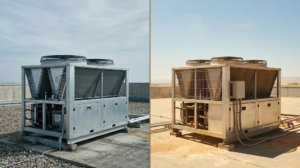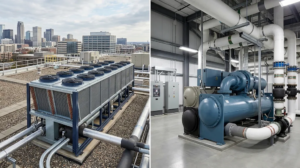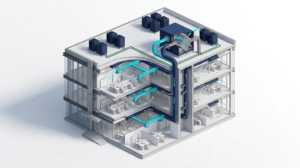
The need for careful selection is growing. The International Energy Agency (IEA) reports that global electricity demand for space cooling in buildings reached approximately 2,900 TWh in 2025, about 50% higher than in 2015. Over the same period, cooling accounted for as much as 25% of electricity-demand growth in the Middle East and North Africa.
The short answer: T1 and T3 identify different climate rating conditions. In ISO 5151-based testing, standard cooling-capacity ratings use an outdoor dry-bulb temperature of 35°C for T1 and 46°C for T3. However, a T3 label alone does not prove full rated capacity at every 50°C or 52°C installation. Buyers must compare corrected capacity and power input at the actual project conditions.
Key Takeaways
- T1 is a moderate-climate rating condition; T3 is a hot-climate rating condition.
- T1 and T3 capacity figures are not directly comparable because their test conditions differ.
- A standard rating, an application rating and a maximum-operating test answer different questions.
- Equipment should be selected against calculated loads and manufacturer data at the project’s design conditions—not by a generic derating percentage.
- For VRF and multi-split projects, confirm the applicable equipment standard and all piping, combination and installation corrections.
What Do T1 and T3 Mean?
T1 and T3 are climate designations used in air-conditioner performance testing. T1 represents moderate climates, while T3 represents hot climates. The tests establish capacity and efficiency under controlled entering-air conditions so that ratings can be reproduced consistently.
The following values come from Tables 1 and 3 of the Pakistan Standards and Quality Control Authority’s published adoption of ISO 5151:
| Test parameter | T1: moderate climate | T3: hot climate |
| Indoor entering air, standard cooling-capacity test | 27°C DB / 19°C WB | 29°C DB / 19°C WB |
| Outdoor entering air, standard cooling-capacity test | 35°C DB / 24°C WB | 46°C DB / 24°C WB |
| Indoor entering air, maximum cooling performance test | 32°C DB / 23°C WB | 32°C DB / 23°C WB |
| Outdoor entering air, maximum cooling performance test | 43°C DB / 26°C WB | 52°C DB / 31°C WB |
DB = dry bulb; WB = wet bulb. The outdoor wet-bulb condition is required only for air-cooled condensers that evaporate condensate.
Two details matter for procurement:
- The standard rating and the maximum performance test are not the same test. The standard cooling-capacity test determines capacity and efficiency. In the ISO 5151-based maximum cooling performance test, determination of cooling capacity and electrical power input is not required; the test evaluates operating performance under the specified sequence.
- A higher test temperature does not make two ratings interchangeable. A capacity published at T1 and a capacity published at T3 must not be compared as though they were measured under identical conditions.
T1 vs T3: What B2B Buyers Should Actually Compare
T3 is not simply a “better” version of T1, and T1 is not automatically the more economical choice. Each designation indicates a test climate. The correct purchasing decision depends on documented performance at the intended application.
| Decision area | What to request | Why it matters |
| Design-day cooling | Total and sensible cooling capacity at the specified indoor and outdoor conditions | Confirms that the selected system can meet the calculated load |
| High-ambient operation | Manufacturer’s operating envelope, protection logic and restart requirements | Reduces the risk of nuisance trips or loss of cooling during extreme conditions |
| Energy and electrical demand | Power input, current and EER at the same conditions used for the capacity comparison | Prevents an equipment selection from overloading the electrical design or distorting the operating-cost model |
| Installation suitability | Clearances, airflow restrictions, ambient limits, coil-protection options and maintenance requirements | A poor equipment layout can raise condenser inlet temperature and reduce performance |
| Evidence and compliance | Test reports and selection data for the exact offered model and indoor/outdoor combination | A generic brochure or family-level claim may not cover the supplied configuration |
Do not assume that every T3 product uses the same compressor, condenser, controls or refrigerant architecture. Evaluate the complete unit and its documented performance rather than inferring engineering features from the label.
Why T3 Does Not Guarantee Full Capacity at 50°C or 52°C
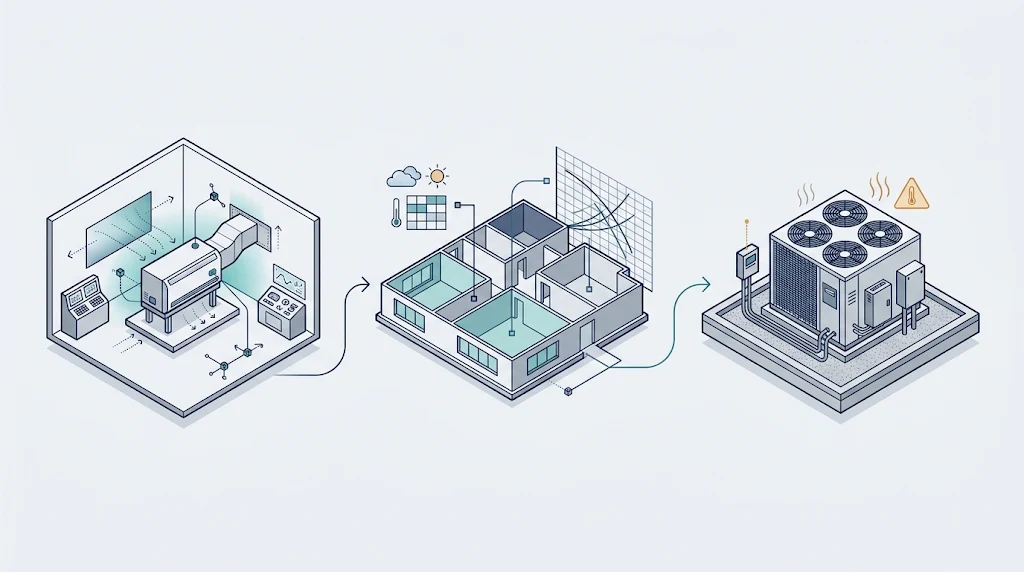
Three numbers are often confused in high-ambient quotations:
1. Standard rated capacity
This is the capacity measured under a defined standard rating condition. It provides a comparison baseline, but it may not represent the project’s design day.
2. Application capacity
This is the capacity available at a stated set of application conditions, such as a particular outdoor temperature, indoor condition, equipment combination and piping arrangement. This is the figure the project team needs for equipment selection.
3. Maximum operating capability
This describes whether the equipment can operate under a defined severe condition. It does not, by itself, state how much cooling the unit delivers at that condition.
In other words, “can operate at 52°C” and “delivers its nameplate capacity at 52°C” are different claims. The same distinction applies to power input and efficiency. Ask for the performance table or manufacturer selection output that supports each claim.
A Six-Step Selection Process for Hot-Climate Projects
Step 1: Establish the project design basis
Document the project location, applicable weather station, required design percentile, indoor temperature and humidity targets, operating schedule and any owner-specified margin. Use the design conditions required by the project engineer and local code rather than selecting from an annual average or the highest temperature ever reported.
ASHRAE Standard 169 climatic design data includes annual cooling dry-bulb temperatures, coincident wet-bulb temperatures, humidity criteria and extreme annual values for thousands of locations. These data support load calculation; they do not replace the project specification.
Also distinguish the weather-station temperature from the actual condenser inlet temperature. Rooftop solar exposure, restricted airflow and discharge-air recirculation can make the equipment’s local environment more severe.
Step 2: Calculate total, sensible and latent loads
Start with a room-by-room or zone-by-zone load calculation. Include the envelope, glazing, orientation, occupancy, lighting, equipment, ventilation and infiltration. Hot-climate projects may also have substantial humidity loads, particularly in coastal locations.
For VRF projects, outdoor-unit selection must follow the zone loads and simultaneous system load rather than a generic kW-per-square-metre rule. George’s commercial VRF sizing guide explains load calculations, diversity, piping limits and manufacturer-specific corrections in more detail.
Step 3: Request capacity at the exact selection conditions
Ask every bidder to state:
- Outdoor and indoor entering-air conditions.
- Total and sensible cooling capacity.
- Power input, current and EER at those same conditions.
- Indoor and outdoor unit models and the tested or selected combination.
- Airflow, fan setting and external static pressure where applicable.
- All corrections applied for ambient temperature, piping, elevation, altitude or other project conditions.
Illustrative calculation only: if a building requires 100 kW of cooling and the manufacturer’s documented selection process produces a combined correction factor of 0.85 at the project conditions, the required nominal selection would be:
100 kW ÷ 0.85 = 117.6 kW
The 0.85 factor is hypothetical, not an industry-average derating value. Never apply it to a real order. Some manufacturer selection programs already include several corrections, so buyers should not multiply separate factors again without checking the calculation method.
Step 4: Check electrical demand and protection
High-ambient performance must be evaluated together with the electrical design. Verify voltage, frequency, phase, allowable voltage range, maximum current, recommended protection and any manufacturer requirements for restart after a power interruption.
A selection that meets the cooling load but exceeds the available electrical service is not a complete solution. Include the resulting power input in demand and operating-cost comparisons rather than relying only on a seasonal efficiency label.
Step 5: Engineer the installation environment
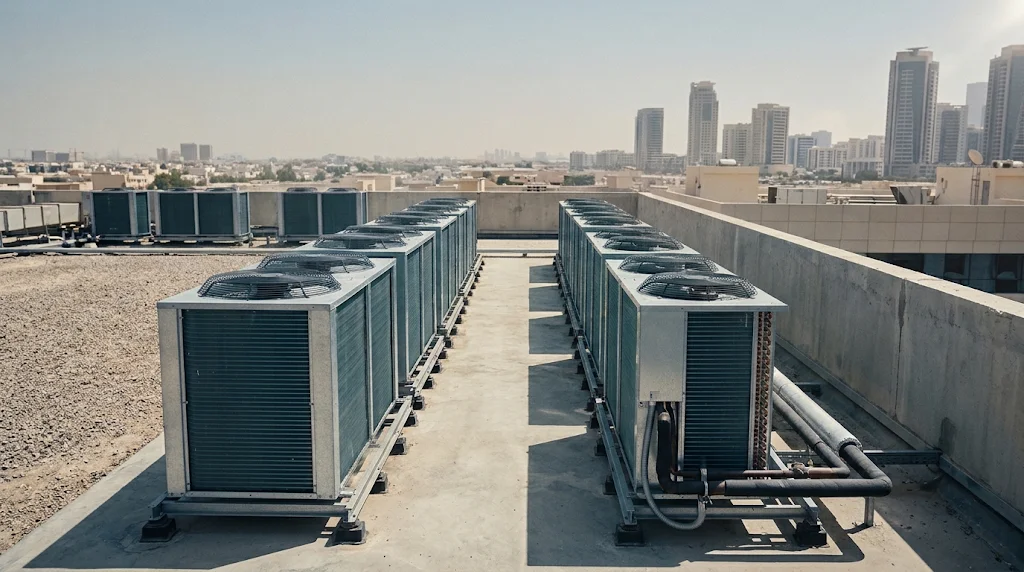
Even correctly rated equipment can underperform when installed poorly. Review:
- Manufacturer-required clearances and service access.
- Discharge-air recirculation between adjacent outdoor units.
- Louvres, walls and other airflow restrictions.
- Rooftop heat exposure and equipment shading where permitted.
- Dust, sand and coil-cleaning access.
- Coastal corrosion and fastener protection.
- Structural loading, vibration and noise transmission.
Hot and coastal conditions require separate treatment. A T3 designation does not certify corrosion resistance. For coastal projects, see George’s HVAC selection and corrosion-protection guide.
Step 6: Verify standards and destination-market compliance
Confirm the applicable performance standard, required edition, national energy-efficiency rules, product registration, safety documentation and refrigerant requirements for the destination market. The evidence should match the exact model and configuration being supplied.
Refrigerant selection also affects future serviceability and market compliance. George’s R410A phase-down guide explains why contractors and importers should check refrigerant requirements before ordering.
Which Rating Standard Applies to the Equipment?
Do not assume that ISO 5151 covers every ducted, multi-split or VRF product. Its scope and exclusions matter when reviewing a specification.
| Equipment type | Relevant rating reference | Key scope point |
| Non-ducted single-package and split systems | ISO 5151:2017 | Also covers certain ducted units rated below 8 kW and below 25 Pa external static pressure; excludes multi-split systems |
| Ducted single-package and split systems | ISO 13253:2017 | Applies to ducted air-cooled air conditioners and air-to-air heat pumps, subject to its stated exclusions |
| Multi-split systems | ISO 15042:2017 | Covers basic, modular and modular heat-recovery multi-split systems within its scope |
| VRF systems above 12 kW | ISO 18107:2026 | Specifies capacity and efficiency testing plus seasonal-performance calculation for VRF within its scope, with regional annexes |
| VRF in the North American rating context | AHRI Standard 1230 | Covers VRF air-source systems at or above 65,000 Btu/h and VRF water-source systems within its scope |
A brochure’s reference to a standard is not automatically evidence of third-party certification or legal acceptance in the destination country. Confirm what was tested, which laboratory or selection method produced the data, and what the local authority requires.
High-Ambient HVAC Procurement Checklist
Use the following checklist in the RFQ and technical submittal. Do not release the purchase order until each applicable item has a documented answer.
- Project city, site elevation and required weather-design basis.
- Indoor temperature, humidity and ventilation design criteria.
- Zone and system loads, including sensible and latent components.
- Applicable equipment standard and required edition.
- Exact outdoor and indoor model numbers and selected combination.
- Total and sensible capacity at the project’s design conditions.
- Power input, current and EER at those same conditions.
- Manufacturer’s maximum operating envelope and protection behavior.
- Ambient, piping, elevation, altitude and other selection corrections.
- Outdoor-unit layout, clearances, airflow restrictions and maintenance access.
- Dust, corrosion, noise and structural requirements.
- Voltage, frequency, phase and electrical-protection requirements.
- Refrigerant, safety, energy-label and product-registration documents.
- Commissioning requirements, warranty terms and recommended spare parts.
Common Specification Mistakes
Choosing by the T3 label alone
A climate designation is only the starting point. The submittal still needs application capacity, power input and an operating envelope for the offered model.
Comparing a T1 kilowatt with a T3 kilowatt
The ratings use different indoor and outdoor conditions. Normalize the comparison to the project’s required conditions before evaluating price or efficiency.
Applying a generic capacity-loss percentage
There is no reliable universal derating factor that applies to every compressor, refrigerant, condenser and control design. Use manufacturer-specific selection data.
Ignoring the outdoor-unit layout
A weather-based selection can be undermined by recirculated discharge air, blocked coils or inadequate service access. Review the layout before production and again before commissioning.
Assuming T3 covers every environmental risk
High-ambient testing does not by itself establish coastal corrosion resistance, dust performance, humidity control or compliance with a national energy-label program.
Where High-Ambient VRF Fits—and When to Compare Other Systems
High-ambient VRF can be a strong option for multi-zone offices, hotels and mixed-use projects where independent control and phased operation matter. The final decision still depends on corrected capacity, electrical demand, piping limits and service capability. For equipment architecture and indoor/outdoor unit options, see George’s VRF system solutions.
George’s Riyadh office VRF project illustrates this system-level approach: high-ambient conditions, rooftop structural constraints, equipment selection and BMS integration were considered together for a 12,000 m², eight-floor office building. The case is not a template for every project, but it shows why the equipment label is only one part of the design.
For large central plants, long operating hours or applications that require chilled-water distribution, compare the complete alternatives rather than defaulting to VRF. George’s air-cooled vs water-cooled chiller guide explains how to compare system efficiency, water use and lifecycle cost.
Frequently Asked Questions
What is the main difference between T1 and T3 air conditioners?
T1 represents moderate-climate rating conditions and T3 represents hot-climate rating conditions. In ISO 5151-based standard cooling-capacity testing, the outdoor dry-bulb condition is 35°C for T1 and 46°C for T3.
Does T3 mean an air conditioner can operate at 52°C?
The ISO 5151-based maximum cooling performance test uses a 52°C outdoor dry-bulb condition for T3 equipment. That does not mean every product marketed as T3 will deliver its standard rated capacity at 52°C. Check the exact model’s operating envelope and application performance data.
Is a T3 air conditioner always more efficient than a T1 model?
No. T1 and T3 describe climate rating conditions, not an efficiency ranking. Compare EER, power input and annual operating performance under consistent, project-relevant conditions.
Can I select equipment using only its nominal kW rating?
No. Confirm the rating condition and corrected total and sensible capacity at the project’s design temperature, indoor conditions and system configuration. For VRF, also apply the manufacturer’s combination, piping and elevation requirements.
Is T3 equipment suitable for every hot coastal project?
Not automatically. Coastal projects also require a review of corrosion protection, humidity, ventilation and maintenance access. These requirements are separate from the high-ambient rating.
What should I send a supplier for a high-ambient quotation?
Provide the project location, required design conditions, drawings, zone loads if available, indoor temperature and humidity criteria, electrical supply, preferred system architecture, outdoor-unit layout and applicable local compliance requirements.
Conclusion: Specify Performance at the Project Condition
The useful question is not simply “Is this unit T1 or T3?” It is “What cooling capacity and power input will this exact system deliver at my project’s design conditions?”
T1 and T3 provide important test references, but a defensible purchase decision also requires load calculations, application ratings, manufacturer corrections, electrical checks, installation review and destination-market compliance. Keeping these items in one technical comparison makes quotations easier to evaluate and reduces the risk of discovering a capacity shortfall after installation.
Planning a hot-climate commercial project? Send George your location, drawings, load information, electrical requirements and proposed outdoor-unit layout through the project contact page. Our team can review the selection basis and prepare a project-specific equipment recommendation and quotation.
Authoritative Sources
- IEA — Cooling a hotter world: El Niño meets strong growth in global electricity demand, July 2026. Global cooling electricity demand and regional demand growth.
- Pakistan Standards and Quality Control Authority — PS: ISO 5151, Tables 1 and 3 and Sections 5.1–5.2. T1/T3 cooling-capacity and maximum cooling performance test conditions.
- ISO — ISO 5151:2017. Scope, equipment coverage and exclusions.
- ASHRAE — Addendum a to Standard 169-2020. Climatic design data for building design.
- ISO — ISO 18107:2026. VRF capacity, efficiency and seasonal-performance methodology.
- AHRI — Standard 1230. VRF rating requirements and scope.
Technical note: Standard requirements and national regulations vary by market and edition. Final equipment selection should be verified by the project engineer against local codes, calculated loads, site conditions and the selected manufacturer’s current engineering data.