First, Why Your House Needs a Ventilator at All
Houses used to breathe on their own. They leaked air around windows, through walls, up chimneys. It was drafty and expensive to heat, but at least the air inside kept changing.
Modern construction fixed the drafts. Insulation, sealed windows, airtight membranes. Great for the heating bill. Not so great for the air. The US EPA points out that people spend about 90% of their time indoors, and that pollutant levels inside are often 2 to 5 times higher than outdoors. Cooking, showers, cleaning products, new furniture, even breathing. In a tight house, all of it stays inside unless something removes it.
You could open a window. But every open window in January or in a July heatwave is air you paid to heat or cool, going straight outside. That’s the whole reason balanced ventilators exist: they swap stale indoor air for fresh outdoor air while hanging on to most of the energy you already paid for.
The Actual Difference Between an HRV and an ERV
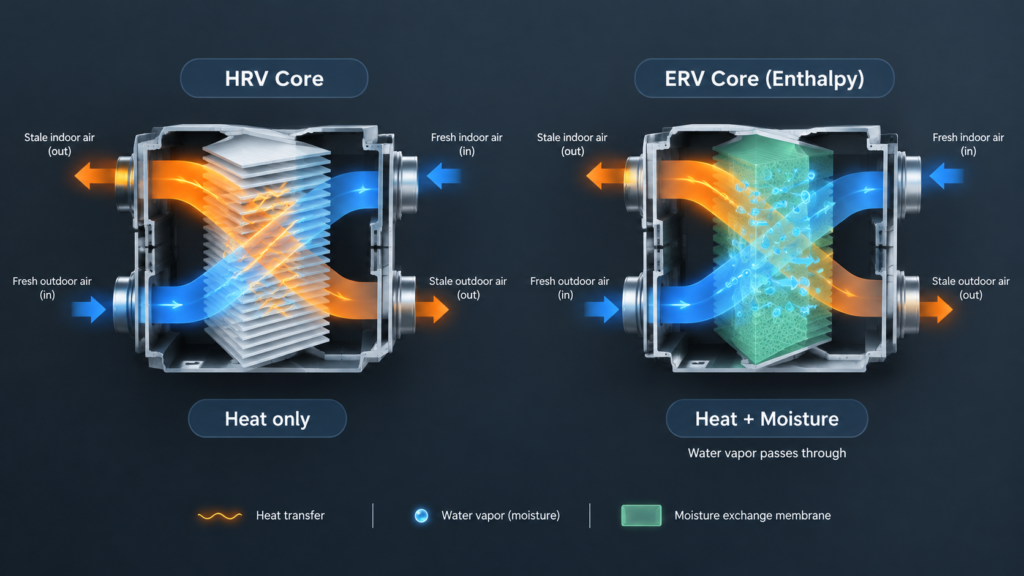
Both boxes do the same basic job. Two fans, two airstreams, one heat exchange core. Stale air out, fresh air in, and the two streams pass close enough to trade heat without ever mixing.
The difference is one word: moisture.
- An HRV (heat recovery ventilator) transfers heat only. Temperature moves between the airstreams; water vapor doesn’t.
- An ERV (energy recovery ventilator) transfers heat and water vapor. Its core is made of a material that lets moisture pass from the humid airstream to the dry one.
That sounds like a spec-sheet detail. It isn’t. Humidity is usually a bigger comfort and energy problem than temperature, and the two machines handle it in opposite ways.
A humid July day makes this obvious. With an HRV, all that wet outdoor air comes straight in, and your air conditioner now has to cool it and dry it. With an ERV, a big share of that moisture gets left behind at the core, so the air entering your house arrives partially pre-dried. In a dry winter the same ERV core works in reverse, holding on to some of your indoor humidity instead of flushing it out.
Efficiency-wise, most certified units recover somewhere between 70 and 80% of the energy in the exhaust air. Entry-level models sit in the 60s, premium counter-flow designs go above 80%, as Panasonic’s IAQ team explains in their breakdown of recovery ratings. Whatever the brochure claims, look for an HVI or AHRI certified rating. That means a lab measured it.
The Climate Rule (and Where It Breaks)
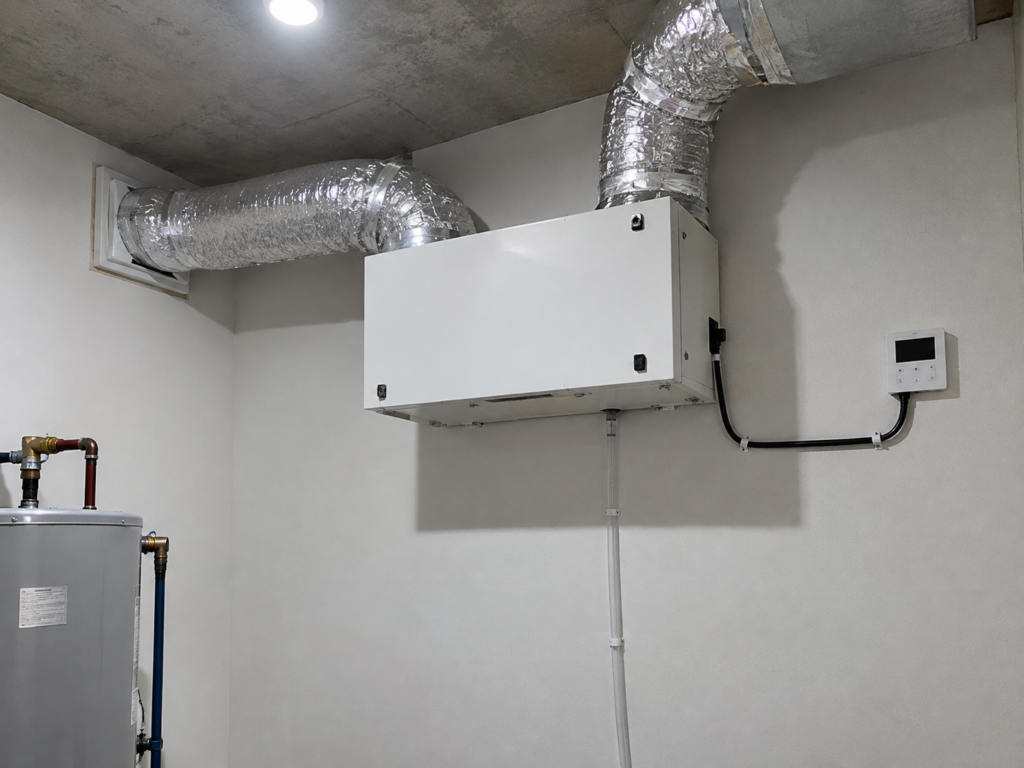
The traditional advice goes like this: HRV for cold climates, ERV for hot and humid ones. It’s mostly right, with one important caveat I’ll get to.
Hot and humid climates. ERV, no contest. Gulf Coast, Southeast Asia, coastal Africa, southern China. The outdoor air carries a heavy moisture load, and every bit of it you let in is load your AC has to remove. An ERV strips much of that moisture out before it enters. You get fresher air and a smaller, cheaper cooling system.
Hot and dry climates. Also ERV, for the opposite reason. In the Middle East or the arid southwestern US, your indoor air holds moisture from cooking, showers and people. You don’t want to throw that away. An ERV keeps indoor humidity from crashing to desert levels.
Cold climates. This is where the HRV earned its reputation. Cold winter air is naturally dry, while your family keeps adding moisture indoors all winter. An HRV dumps that excess humidity outside, which protects windows and walls from condensation and mold. If you live in Minnesota or Manitoba and your windows drip every winter, an HRV is the classic fix.
Mixed climates. Humid summers, real winters: most of the US Midwest and Northeast, Central Europe. Either machine works. The industry has been drifting toward ERVs because summer humidity control tends to matter more for comfort, and modern ERVs handle winter fine.
Now the caveat. The old “cold climate equals HRV” rule assumed houses that leak moisture easily. If your cold-climate home is small, very airtight, or has lots of occupants, indoor humidity can still run too high even with an HRV… but the more common modern problem is the reverse: air that gets painfully dry all winter. Plenty of cold-climate builders now spec ERVs for exactly that reason. The honest answer is that in cold climates, the choice depends on your house’s moisture balance, not just your latitude. If dry winter air, static shocks and cracked lips are your annual complaint, an ERV helps. If wet windows are your complaint, go HRV.
One cold-climate must-have regardless of type: a defrost cycle. Frost can choke the core in severe cold, so whatever you buy needs a way to deal with it.
What It Does to Your Energy Bill
Here’s the part most articles skip: ventilation isn’t free, it’s just cheaper with recovery.
Every cubic foot of outdoor air you bring in has to be heated or cooled to room temperature. In commercial buildings, conditioning fresh air commonly eats 20 to 40% of total HVAC energy. Homes aren’t that extreme, but in a tight, well-ventilated house the ventilation load is a real line item.
Say it’s 95°F and steamy outside, 75°F inside. Without recovery, your AC handles the full gap plus all the humidity. With an ERV recovering 75% of the exhaust energy, your AC only deals with the remaining quarter. The wider the gap between indoors and outdoors, the more the core saves you. That’s why payback is fastest in the harshest climates and slowest in mild ones.
Zooming out, this is why the market keeps growing. Cooling alone already accounts for around 10% of global electricity use and roughly a fifth of electricity consumed inside buildings, according to IEA figures cited by the European Commission’s BUILD UP portal. Anything that shaves cooling load compounds over thousands of hours of runtime. Analysts at Fortune Business Insights expect the global ERV market to nearly double from $3.44 billion in 2022 to about $6.67 billion by 2030, driven largely by tighter building codes and post-pandemic attention to indoor air.
Sizing: A Two-Minute Calculation
For houses, the common baseline is ASHRAE Standard 62.2:
CFM needed = 0.03 × floor area (sq ft) + 7.5 × (bedrooms + 1)
A 2,000 sq ft house with 3 bedrooms needs about 90 CFM of continuous ventilation. Then buy a unit rated comfortably above that and run it on low. A bigger unit loafing along is quieter and lasts longer than a small one screaming at full speed.
Commercial spaces follow ASHRAE 62.1, which sets rates per person plus per square foot by occupancy type. Offices need 5 CFM per person plus 0.06 CFM per square foot; classrooms and gyms need much more. If you’re speccing a commercial project, that’s engineering territory, and it’s worth doing properly. (Our commercial ERV systems page covers the heavier-duty end of this.)
A cheap sanity check for any building: watch CO2. Outdoor air sits around 420 ppm. If an occupied room consistently reads past 1,000 ppm, it’s under-ventilated, whatever the design documents claim.
FAQ
Can I use an ERV in a cold climate?
Yes. Thousands do. Just make sure it has a proper defrost strategy, and accept that it will hold more moisture indoors in winter. In many cold-climate homes that’s a feature, not a bug.
Which costs more, an ERV or an HRV?
Similar. ERV cores are slightly more complex, so comparable ERV models often run a bit higher, but the install cost is basically identical. Don’t choose on price. Choose on climate.
Do I still need bathroom and kitchen fans?
Yes. Range hoods are non-negotiable because grease and combustion byproducts will wreck a recovery core. The ventilator’s exhaust ports belong in bathrooms, laundry rooms and general living areas, not above your stove.
How much maintenance does an ERV or HRV need?
Filters every few months, core wash once or twice a year, done. Skip it and efficiency quietly bleeds away. This is the same story as any HVAC equipment, as anyone who has read our heat pump maintenance guide already knows.
Is an ERV overkill if I already have air conditioning?
Your AC recirculates indoor air. It doesn’t replace it. Cooling and ventilation are two separate jobs, which is why an ERV pairs with an AC system rather than replacing one. In humid climates it actually makes the AC’s job smaller.
If You’re Speccing Equipment, Three Things to Check
Whether it’s one unit for a house or fifty for a project:
- Certified performance. HVI or AHRI listing, tested under ASHRAE Standard 84. Ask for the actual test data, not a marketing badge.
- The right core for your climate. Enthalpy core for anywhere humid, with published latent (moisture) effectiveness, not just the sensible number.
- Consumables you can actually buy. Filters and cores wear out. If replacements aren’t available in your market, the unit is disposable.
Cold-climate buyers can cross-reference our cold climate heating and ventilation guide, and if your project sits near the ocean, moisture isn’t your only enemy; salt is. Our coastal HVAC corrosion guide covers that side.
The Bottom Line
ERV vs HRV isn’t really a question about machines. It’s a question about water. Too much indoor moisture in a cold dry climate points to an HRV. Outdoor humidity in a hot or mixed climate points to an ERV. And if you genuinely can’t decide, the ERV is the more forgiving choice in most of the places where the world’s construction is actually happening.
George Air Condition builds both residential and commercial ERV ventilation systems, with CE, ISO9001 and SGS certified manufacturing. If you tell us your climate zone and send your floor plans, our engineers will size the system, pick the right core, and quote it factory-direct. Talk to us here.
Sources
- US EPA – Report on the Environment: Indoor Air Quality
- US EPA – Why Indoor Air Quality is Important to Schools
- Panasonic IAQ – Sensible Recovery Efficiency: How to Compare HRVs and ERVs
- European Commission BUILD UP – Passive cooling (citing IEA cooling data)
- Fortune Business Insights – Energy Recovery Ventilator Market (via GlobeNewswire)
- ASHRAE Standards 62.1, 62.2 and 84 (ashrae.org)