In 2026 three forces are pushing more projects toward VRF: the global phase-down of high-GWP refrigerants under the Kigali Amendment and the EU F-Gas Regulation, tighter part-load efficiency requirements across most major markets, and electricity tariffs that have turned part-load performance into a line item rather than a footnote.
This guide is written for developers, mechanical contractors, and procurement teams who specify or import VRF equipment. It covers how the technology works, what a system actually costs — both installed on site and at the factory gate — and how to select the right configuration for your building type, climate, and target market’s compliance regime.
Key Takeaways
- VRF modulates refrigerant flow to each zone independently, so it conditions only what needs conditioning. The savings come from part-load performance, not peak efficiency.
- Equipment typically accounts for 40–60% of a VRF project’s total installed cost. Where you source it moves the total more than any other single decision.
- Heat recovery systems transfer heat between zones — cooling one area while heating another. They suit mixed-load buildings such as hotels, hospitals, and mixed-use developments.
- Two-pipe (heat pump) and three-pipe (heat recovery) systems are not interchangeable. The choice drives both piping cost and day-to-day operating flexibility.
- Sizing is load-driven, not area-driven. A room-by-room load calculation is the first deliverable of any serious project, not an afterthought.
- Refrigerant choice is now a procurement decision: R-32 and R-454B are displacing R-410A, and the choice affects compliance in the EU, the Gulf, and increasingly elsewhere.
What Is Variable Refrigerant Flow?
Variable refrigerant flow is a multi-split air conditioning method that controls how much refrigerant reaches each indoor unit. Electronic expansion valves and zone-level controls regulate that flow, so every zone receives only the capacity it actually needs.
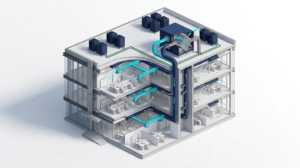
A single outdoor condensing unit connects to many indoor units through a network of refrigerant piping. Larger buildings link several outdoor units together in a modular arrangement. In capacity terms, VRF sits between large central chiller plants and individual split units — it offers the zoning flexibility of the latter with the capacity of the former.
The defining trait is zone-by-zone refrigerant regulation based on real-time demand. One caveat worth stating up front: VRF moves heat, it does not bring in outside air. Every VRF project needs a separate ventilation strategy, which we cover below.
VRF vs. Traditional HVAC
Traditional ducted systems cool a whole building from one central unit. They push conditioned air through long duct runs. A VRF system uses refrigerant as the heating and cooling medium instead. It moves thermal energy directly to each zone. This approach cuts ductwork dramatically. Ducts serve only the ventilation component, so they can be smaller. Smaller ducts lower building height and cost. In many cases, the design minimizes or eliminates ductwork entirely. Duct leakage losses drop as a result.
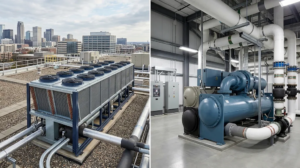
air-cooled vs water-cooled chillers
This difference matters most in retrofits. Older buildings often cannot accept new ductwork. Running ducts through existing structures is disruptive, expensive, or impossible. VRF systems require far less ductwork than forced-air systems. That makes them a practical choice for renovations. Zone-level control adds another advantage. Occupants set individual temperatures by area or occupancy pattern. Only occupied zones get conditioned. Energy waste from conditioning empty space disappears.
Duct losses are worth quantifying here. In a conventional forced-air system, distribution losses commonly run 10–30% of delivered capacity depending on duct length, insulation, and leakage. Because a VRF system delivers capacity through refrigerant piping instead, that loss largely disappears — which is why the efficiency gap between VRF and conventional systems is often wider in the field than it looks on a spec sheet.
Core Components
Every VRF system shares the standard refrigeration cycle components: compressor, fan, coil, metering device, and controls. What sets these systems apart is the piping network and the control layer sitting on top of it.
Inverter-driven compressors vary speed continuously instead of cycling on and off. That is the core of the technology, and the reason part-load efficiency is so strong.
Electronic expansion valves at each indoor unit meter refrigerant independently, which is what makes per-zone control possible.
Refrigerant piping is the distinguishing feature. Depending on the manufacturer and series, total piping runs can exceed 1,000 m and a single system can serve up to around 80 indoor units. Treat these as manufacturer-specific limits, not industry-wide constants — always verify against the engineering data for the series you are buying.
On refrigerant: R-410A is being phased down in most major markets. New equipment in 2026 is increasingly built around R-32 or R-454B. We cover the trade-offs in detail in our comparison of R-32 vs R-410A.
How Variable Refrigerant Flow Technology Works
A VRF system works by matching refrigerant flow to each zone’s real-time load. Inverter-driven compressors change speed to meet demand. Electronic expansion valves open and close with precision. This combination delivers exact capacity to every indoor unit. No zone receives more cooling or heating than it needs. The result is precise zone control without the energy waste of on-off cycling.
The Heating and Cooling Cycle
The cycle starts at the outdoor unit. The compressor pressurizes refrigerant and sends it through piping to indoor units. Each indoor unit’s expansion valve regulates how much refrigerant enters its coil. The coil absorbs heat from the room during cooling. It releases heat into the room during heating. Refrigerant then returns to the outdoor unit to repeat the cycle.
This process differs from traditional HVAC operation. A conventional system runs at full capacity or shuts off. A VRF system modulates continuously. Capacity rises and falls with the actual load. When a zone reaches its setpoint, the valve for that unit reduces flow. Other zones keep receiving refrigerant. This independent regulation is the heart of variable refrigerant flow technology.
Heat Pump vs. Heat Recovery
Heat pump systems run all indoor units in the same mode — either heating or cooling. Heat recovery systems use a branch controller to route refrigerant between zones, so one area can be cooled while another is heated. Heat removed from a cooling zone is transferred to a zone that needs it, which reduces the work the compressor has to do.
The practical rule: if your building has zones with genuinely different simultaneous loads — a sun-facing wing against a shaded one, guest rooms against a lobby, server rooms against occupied space — heat recovery pays for itself. If loads are broadly uniform, a heat pump system does the job for less money.
→ VRF heat pump vs heat recovery: which one does your building need? — full decision framework, including branch controller layouts and mode changeover behaviour.
What VRF Systems Cost
VRF carries a higher upfront cost than conventional packaged or split equipment. But “the cost of a VRF system” is two very different numbers depending on who you ask, and conflating them is where most budgets go wrong.
- Installed cost — everything: equipment, refrigerant piping, controls, electrical, labour, commissioning, permits. This is what a building owner pays.
- Equipment cost — the outdoor units, indoor units, and branch controllers leaving the factory. This is what an importer or contractor pays before local labour and materials.
Both matter, and the relationship between them is the single most useful thing a buyer can understand.
Installed Cost: The Benchmark
For commercial VRF in most markets, installed cost typically lands in this range:
| System Type | Installed cost per ton of cooling |
|---|---|
| Rooftop / packaged unit | $1,500 – $3,200 |
| Conventional split system | $1,800 – $3,400 |
| VRF / VRV | $2,800 – $4,500 |
| Commercial heat pump | $2,200 – $3,800 |
Figures are market averages for commercial projects at moderate complexity. Regional labour rates, roof access, and piping runs move them substantially — treat them as a sanity check on a quote, not a substitute for one.
What is more useful than the headline number is the breakdown. Across the sources above, the pattern is consistent:
| Variable | Effect on equipment price |
| Brand tier | Japanese and US premium brands carry a significant premium over Chinese first-tier equivalents at comparable ratings |
| Capacity band | Cost per kW falls as capacity rises; a 10 kW outdoor unit costs far more per kW than a 60 kW module |
| Indoor unit type | Wall-mounted is cheapest; ceiling cassettes and concealed ducted units can run 30–50% more per zone |
| Heat recovery vs heat pump | Three-pipe heat recovery adds roughly 15–25% over a comparable two-pipe heat pump system |
| Refrigerant | R-32 and R-454B equipment carries a modest premium over legacy R-410A stock, and is increasingly the only compliant option |
| Controls and BMS integration | Proprietary central controllers and BACnet/Modbus gateways are priced separately — often overlooked in early budgets |
| Order quantity | MOQ and container consolidation matter more than buyers expect; a part container costs disproportionately more per unit than a full one |
| Voltage and certification | 60 Hz / 380–415 V variants, UL listing, or SASO conformity add cost and lead time |
Two practical implications for importers and contractors:
Lock the specification early. Every change to indoor unit types, capacity, or refrigerant after production starts costs more than the same change made on paper.
Consolidate to fill containers. Because equipment is the largest single line, freight efficiency per unit has an outsized effect on landed cost.
Life-Cycle Savings and ROI
The higher upfront cost is only half the picture. VRF modulates compressor speed continuously rather than cycling, and it conditions only occupied zones. Buildings with many zones see the strongest payback — hotels, schools, hospitals, and multi-tenant offices run different loads in different areas throughout the day.
Maintenance also favours these systems over time: fewer moving parts, no extensive ductwork, and routine service concentrated on filters, coils, and refrigerant charge verification.
The right comparison is never sticker price against sticker price. It is the upfront premium weighed against years of lower utility bills and reduced service calls. For multi-zone commercial buildings, that math usually favours VRF — provided the system is sized correctly. An oversized system in a humid climate will short-cycle, fail to dehumidify, and erase most of the efficiency advantage.
Types of VRF HVAC Systems
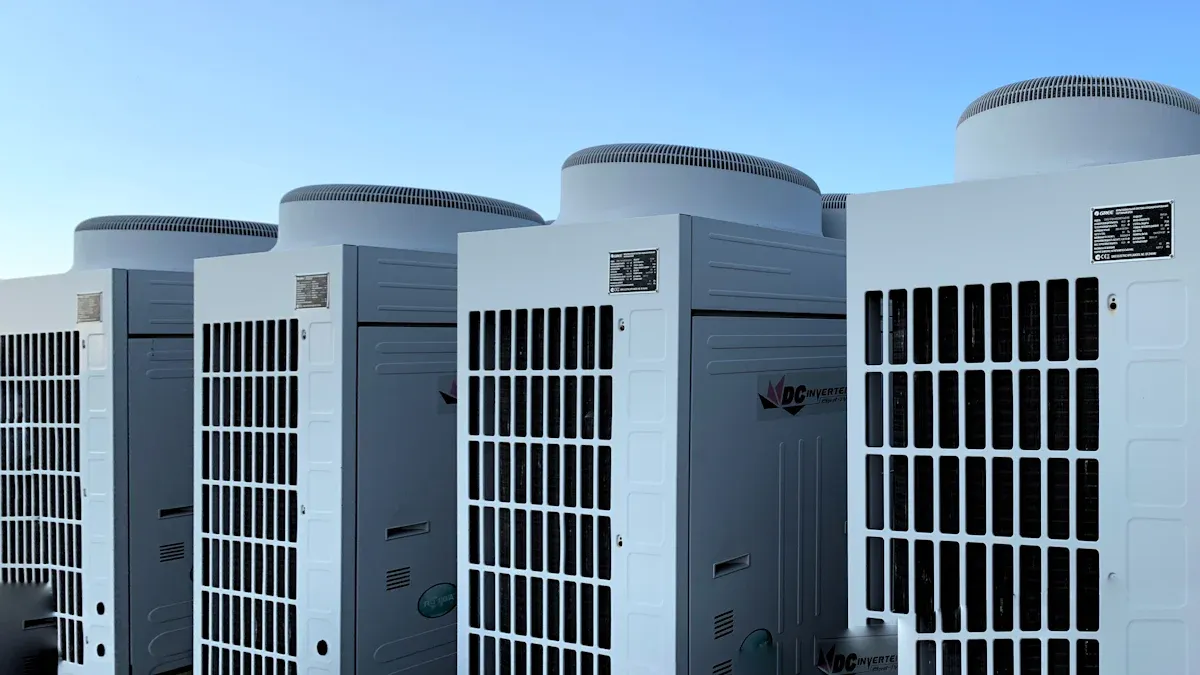
Two main types define VRF HVAC systems for commercial applications. Heat pump systems make up 58.4% of the market. Heat recovery systems account for the remainder. Heat pump systems provide either heating or cooling at one time. Heat recovery systems allow simultaneous heating and cooling in different zones. This difference drives piping and application choices.
| VRF System Type | Market Share |
|---|---|
| Heat pump systems | 58.4% |
| Heat recovery systems | Remaining |
Two-Pipe, Three-Pipe, and Four-Pipe
Piping configuration determines capability:
| Configuration | Lines | Capability | Typical use |
| Two-pipe | Liquid + gas | Heat pump only — all indoor units share one mode | Open-plan offices, retail, uniform loads |
| Three-pipe | Liquid + gas + hot gas | Heat recovery — simultaneous heating and cooling | Hotels, hospitals, mixed-use |
| Four-pipe | Separate hot and cold circuits | Heat recovery, alternative layout | Large mixed-load buildings |
Piping cost and installation labour both rise with complexity. The premium is real, but so is the operating flexibility — see the heat pump vs heat recovery comparison for how to decide.
Best Applications by Building Type
| Building type | Recommended configuration | Why |
| Open-plan offices, retail | Heat pump (two-pipe) | Uniform loads; simultaneous heating and cooling rarely needed |
| Hotels, hospitals | Heat recovery (three-pipe) | Guest rooms and lobbies have opposing loads at the same hour |
| Mixed-use developments | Heat recovery | Retail, office, and residential zones peak at different times |
| Schools, multi-tenant offices | Heat pump, often zoned per wing | Occupancy schedules are predictable and broadly aligned |
| Existing buildings / retrofits | Either, depending on load | Minimal ductwork makes VRF viable where conventional systems are not |
| Industrial process cooling | Usually not VRF | High sensible loads and tight tolerances suit chiller plants better |
One honest boundary: VRF excels at comfort cooling with varied zone loads. It is not the right answer for process cooling, cleanrooms, or spaces with strict humidity and filtration requirements. Putting that line on paper early saves everyone time.
How to Choose a VRF System
Selecting the right VRF system requires matching equipment to building needs. Three factors guide the decision: building size, climate, and budget.
Sizing, Climate, and Load Calculations
Sizing drives everything else. An undersized system cannot hold setpoints on design days; an oversized one short-cycles, wastes energy, and in humid climates fails to dehumidify properly.
The starting point is a room-by-room load calculation — orientation, insulation, glazing, occupancy, lighting, equipment, ventilation, and infiltration — not a rule of thumb based on floor area. Diversity factor then lets you specify an outdoor unit smaller than the sum of the indoor units, because zones rarely peak simultaneously.
→ VRF system sizing for commercial buildings — the full step-by-step process, including piping length corrections, elevation limits, and connection ratio.
Compliance and Refrigerant
Efficiency requirements and refrigerant rules are set by your market, not by the manufacturer. Confirm both before you specify.
Efficiency testing. VRF performance is measured under AHRI 1230, which produces the IEER and EER ratings used in most commercial specifications. Lighter equipment under 65,000 Btu/h is typically rated under AHRI 210/240 (SEER2). When comparing quotes, make sure both suppliers are quoting to the same standard — IEER and SEER2 are not interchangeable.
By market:
| Market | What to verify |
| European Union | Ecodesign / ErP lot requirements, energy label, and F-Gas Regulation GWP limits on the refrigerant |
| Gulf (Saudi, UAE, Qatar) | SASO conformity (Saudi), G-Mark, and increasingly high-ambient performance at 50°C+ |
| Southeast Asia | Typically CE or CB scheme acceptance; check local electrical authority requirements |
| Africa | Usually CE plus national standards body registration; verify voltage and frequency stability assumptions |
| North America | DOE minimum efficiency under 10 CFR 431.97; AHRI certification; state codes such as Title 24 where applicable |
Refrigerant. Two A2L mildly flammable refrigerants now lead the transition away from R-410A:
| Refrigerant | GWP | Typical VRF application |
| R-32 | 675 (about 68% lower than R-410A) | Light commercial VRF |
| R-454B | 466 | Larger VRF above roughly 20 kW |
Both require equipment designed specifically for them — different lubricants, adjusted expansion valves, and compressors rated for higher discharge temperatures. Neither is a drop-in retrofit for existing R-410A systems. Confirm which refrigerant the series you are buying is built for, and confirm your market accepts it. Our R-32 vs R-410A comparison covers the practical implications.
Benefits and Drawbacks of VRF Systems
Where VRF Excels
VRF performs best where loads vary by zone and by time of day:
| Application | What VRF delivers |
| Open-plan offices | Uniform heating or cooling from a heat pump configuration at lower part-load cost |
| Hotels and hospitals | Heat recovery moves waste heat from cooling zones to zones needing heat |
| Mixed-use developments | Independent schedules per tenant without separate plants |
| Retrofits and heritage buildings | Minimal ductwork where conventional distribution is impossible |
| Suburban office parks | Unoccupied wings shut down individually instead of running a central plant |
The common thread is variability. The more a building’s load varies by zone, the more VRF’s modulation is worth.
Limitations to Consider
Most published VRF comparisons stop at the benefits. Facility managers who live with these systems report a different set of realities, and they are worth knowing before you commit:
Refrigerant circuit complexity can cause silent energy waste before any fault alarm triggers. A single indoor unit fault can cascade to outdoor unit failure. Proprietary protocols can leave diagnostic data inaccessible to standard BMS platforms. Common field issues include expansion valve hunting, sensor drift, and communication bus problems. Thermistor misreads cause control inaccuracies and comfort complaints that look like capacity problems but are not. Low suction with high compressor frequency across many indoor units indicates refrigerant starvation; high suction points to undercharge.
None of these are reasons to avoid VRF. They are reasons to specify it carefully and to insist on proper commissioning — which is why the support your supplier provides matters as much as the equipment itself.
Ventilation: The Gap VRF Does Not Fill
VRF conditions recirculated air. It does not introduce outside air, and every occupied building needs ventilation to meet standards such as ASHRAE 62.1 or EN 16798.
That means a VRF project almost always needs a dedicated outdoor air system (DOAS) alongside it. In hot and humid climates this is not optional — the ventilation load is a large share of the total, and undersizing it is one of the most common specification errors we see. Pairing VRF with an energy recovery ventilator (ERV) pre-conditions incoming air using exhaust air, which cuts the ventilation load substantially rather than dumping it onto the VRF system.
Two related points worth budgeting for: in high-humidity markets, discuss dehumidification capacity explicitly with your designer. And where a single refrigerant circuit serves occupied spaces, ASHRAE 15 and its local equivalents may require refrigerant leak detection — a real line item that is easy to miss in early budgets.
VRF Maintenance and Lifespan

Routine Service Requirements
Manufacturers recommend regular maintenance for VRF systems. At minimum, technicians should inspect a VRF system twice each year before heating and cooling seasons. Regular filter cleaning and coil inspection help maintain performance.
Common Issues and Repair Costs
Repair costs vary by failure type. Inverter drives and PCB boards are the expensive failures, and they are expensive largely because they are frequently misdiagnosed as compressor problems. Refrigerant leaks left unattended lead to compressor failure, which is the single most costly outcome in a VRF system.
Annual maintenance cost scales with system size. A well-maintained VRF system typically delivers a service life of 15–20 years, comparable to or better than conventional commercial equipment — provided commissioning was done properly at the start.
How to Select a VRF Contractor
Certifications and Manufacturer Training
Proper installation of VRF systems demands a contractor with specific credentials. The HVAC industry now relies on complex, high-efficiency equipment that uses proprietary software for diagnostics. Standard training does not cover these systems.
Manufacturers offer specialized certifications for their own equipment. A factory-certified VRF technician becomes a sought-after specialist.
The full VRF Technician Course gives technicians hands-on experience with all major VRF types. This training ensures they understand heat pump and heat recovery configurations. Buyers should ask for proof of these credentials before hiring.
Questions to Ask Before Signing
Asking the right questions helps separate qualified contractors from generalists. Start with their certification history. Request documentation of manufacturer-specific training for the brand they plan to install. Verify that the training is current. Certifications expire or update as new models release.
Ask about their experience with similar buildings. A contractor who installed VRF HVAC systems in hotels understands heat recovery applications. One who works only on residential projects may not handle a commercial building’s complexity.
Request references from recent VRF installations. Contact those building owners about system performance and service response times. Ask whether the contractor handled any post-installation issues promptly.
Confirm the scope of the warranty and service agreement. Understand what parts and labor the warranty covers. Ask about the contractor’s response time for emergency repairs. Reliable support after installation matters as much as proper setup.
These questions help buyers find a qualified contractor. Proper selection of both equipment and installer determines long-term satisfaction with VRF systems.
VRF systems work by matching refrigerant flow to each zone’s real-time load. They cost more upfront than conventional equipment, yet energy savings and lighter maintenance often offset that premium over the life of the system. Choosing well comes down to building size, climate, and budget, not brand hype.
VRF works by matching refrigerant flow to each zone’s real-time load. It costs more upfront than conventional equipment, and energy savings plus lighter maintenance usually repay that premium over the system’s life — but only if the system is sized and commissioned correctly.
Choosing well comes down to building type, climate, and the compliance regime of your market. Brand reputation matters far less than whether the configuration matches how your building is actually used.
Next step: send us your floor plans and project requirements. We will run the load analysis, match the equipment, and return a specification and quotation within 24 hours — including the piping design your installation team will need. Contact us.
FAQ
How does a VRF system differ from a traditional HVAC system?
A traditional ducted system cools a whole building from one central unit. A VRF system uses refrigerant as the heating and cooling medium. It moves thermal energy directly to each zone. This design cuts ductwork dramatically and allows zone-level control. Only occupied zones get conditioned, which reduces energy waste.
Can a VRF system heat and cool different zones at the same time?
Yes, but only heat recovery models offer this capability. Heat pump systems provide either heating or cooling at one time. Heat recovery systems use a branch controller to direct refrigerant between zones. One area can receive warm air while another gets cool air. This is a defining VRF capability.
How long does a VRF system last?
A well-maintained VRF system can last many years, with proper installation and maintenance extending its service life.
How often does a VRF system need maintenance?
Technicians should inspect a VRF system at least twice each year. These inspections happen before heating and cooling seasons. Monthly tasks include cleaning or replacing indoor air filters. Quarterly or seasonal visits cover condenser coil cleaning and refrigerant charge verification. Annual diagnostics pull full fault-code history from the outdoor unit.
What refrigerant do new VRF systems use in 2026?
Two A2L mild-flammability refrigerants lead the transition from R-410A. R-32 has a GWP of 675, which is 68% lower than R-410A. R-454B has a GWP of 466. Each refrigerant requires equipment designed for its specific properties. Neither works as a field retrofit for existing R-410A systems.