Introduction
Global refrigerant regulations are transforming commercial and residential HVAC procurement faster than many international buyers anticipated. If you are an overseas contractor, project developer, or equipment distributor sourcing systems from China over the next 6 to 24 months, the landscape has fundamentally changed. The familiar default choice — R410A — is rapidly disappearing from major international markets.
Ordering the wrong equipment platform today risks severe commercial friction: blocked shipments at customs ports, unsellable inventory, code violations on job sites, and long-term refrigerant supply shortages that leave end users stranded.
Understanding the ongoing R410A phase down is no longer just an environmental concern; it is an urgent financial and operational safeguard. This guide provides international buyers with a definitive, practical roadmap. We cover why the phase-down is accelerating globally, break down the specific timelines mandated by the United States and the European Union, evaluate low GWP refrigerant alternatives like R32 vs R410A, R454B, and R290, and outline a sourcing checklist for your next container order from China.
Why R410A Is Being Phased Down
For more than two decades, R410A served as the primary hydrofluorocarbon (HFC) refrigerant for light-commercial split air conditioners, heat pumps, and Variable Refrigerant Flow (VRF) systems worldwide. However, its environmental footprint has made it the primary target of international climate accords, particularly the Kigali Amendment to the Montreal Protocol.
The metric driving these regulatory phase-downs is Global Warming Potential (GWP), which measures how much heat a greenhouse gas traps in the atmosphere over 100 years relative to carbon dioxide (CO₂, which has a baseline GWP of 1). R410A carries a GWP of approximately 2,088.
1 kg of R410A released into the atmosphere = 2,088 kg (2.1 tonnes) of CO₂ equivalent.
In high-capacity commercial setups such as VRF refrigerant circuits — which can contain tens or hundreds of kilograms of charge — a single catastrophic leak creates a massive environmental footprint.
Compounding the problem is an unprecedented surge in global cooling demand. According to the International Energy Agency (IEA), space cooling already accounts for approximately 10% of global electricity consumption and nearly 20% of the total electricity consumed inside buildings today. Furthermore, cooling equipment contributes around 30% of peak electricity demand worldwide, placing immense stress on electrical grids during hot summer afternoons.
IEA data shows that electricity demand for space cooling has expanded by roughly 50% since 2015, reaching approximately 2,900 TWh in 2025. Yet the global market is only at the beginning of this adoption curve:
- Only about 8% of the 2.8 billion people living in the world’s hottest regions currently own an air conditioner.
- In contrast, ownership rates exceed 90% in developed markets like the United States and Japan.
- The IEA estimates that without targeted energy efficiency and refrigerant policies, global cooling energy demand could more than double by 2050 (earlier IEA models projected it could more than triple).
- The total volume of air conditioning units in operation globally is projected to surge from under 2 billion units in 2016 to around 6 billion units by 2050.
Under the IEA’s Efficient Cooling Scenario, enforcing stringent energy performance standards and adopting efficient equipment can cut projected 2050 cooling energy demand nearly in half — lowering consumption to 3,400 TWh instead of a business-as-usual 6,200 TWh. This 2,800 TWh saving roughly equals the entire electricity consumption of the European Union in 2016. Because modern low-GWP refrigerants also yield superior thermodynamic efficiencies, phasing down R410A is fundamental to achieving these efficiency gains.
United States: The AIM Act Timeline
For contractors and distributors importing HVAC equipment into the United States or supplying US-bound projects, federal policy is governed by the American Innovation and Manufacturing (AIM) Act of 2020. Administered by the US EPA through its Technology Transitions program, the AIM Act mandates an orderly reduction in HFC production and consumption:
| Period | HFC Production & Consumption Cap (vs. Baseline) |
| Baseline | 100% |
| 2029–2033 | 30% |
| 2034–2035 | 20% |
| From 2036 | 15% |
Under this schedule, the US EPA has established legally binding GWP limits that disallow R410A across various equipment categories:
- Residential and Light-Commercial Systems: Effective January 1, 2025, all newly manufactured or imported residential and light-commercial air conditioning and heat pump systems must utilize refrigerants with a GWP below 700. Because R410A has a GWP of ~2,088, it can no longer be manufactured or imported into the US for these applications.
- Chillers: Comfort-cooling chillers are held to the same standard. Since January 1, 2025, comfort-cooling chillers entering the US market or rolling off manufacturing lines must meet the sub-700 GWP threshold.
- Variable Refrigerant Flow (VRF) Systems: Recognizing the extended engineering, bidding, and construction cycles of large-scale commercial developments, the US EPA established a staged transition for VRF equipment:
- Field installation of new VRF systems utilizing refrigerants with a GWP above 700 is permitted until January 1, 2027, provided that all system components (condensers, fan coils, branch controllers) were manufactured or imported prior to January 1, 2026.
- For long-horizon construction projects with building permits approved before October 5, 2023, installation of such VRF systems is permitted until January 1, 2028.
- EPA Reconsideration Rule for Legacy Inventory: In a reconsideration rule published on May 26, 2026 (effective July 27, 2026), the US EPA officially removed the original installation deadline for pre-2025 residential and light-commercial equipment inventory. This update allows distributors and contractors to install pre-existing, legally imported or manufactured R410A systems until warehouse inventory runs out. However, this does not permit new manufacturing or importing: the ban on importing and producing new R410A equipment remains fully in force.
- Servicing and Existing Infrastructure: Servicing existing R410A systems remains completely legal across the United States. The EPA has not imposed a mandatory equipment retrofit or premature retirement schedule. However, because national HFC supply will drop to 30% of baseline during 2029–2033, and to 20% in 2034–2035, virgin R410A availability will constrict, driving up field servicing costs.
- State-Level Nuances: Importers must remember that individual states retain the legal authority to enact local rules that move faster than federal mandates. For example, states like New York have codified regulatory frameworks with stricter compliance windows. Always confirm local municipal and state building codes prior to procurement.
European Union: F-Gas Regulation (EU) 2024/573
Buyers importing cooling equipment into the European Union operate under one of the world’s most aggressive regulatory structures: Regulation (EU) 2024/573, which entered into legal force on March 11, 2024.
The updated EU F-Gas Regulation targets a rapid reduction of fluorinated gases, driving the quota allocated to producers down to zero by 2050:
| Period | EU HFC Quota (% of 2015 Baseline) |
| 2025–2026 | ~24.3% |
| 2027–2029 | ~12.3% |
| 2030–2032 | ~5.2% |
| From 2050 | 0% |
Because the quota mechanism restricts the total volume of high-GWP refrigerants that can be placed on the market, pricing for high-GWP gases escalates well before explicit product bans take effect.
Beyond quotas, Regulation (EU) 2024/573 establishes definitive product bans across specific capacity bands:
- January 1, 2025: A ban took effect prohibiting the placing on the market of single split systems containing less than 3 kg of F-gas with a GWP ≥ 750. This definitively eliminated R410A (GWP ~2,088) residential split units across EU member states.
- January 1, 2027:
- Monobloc and self-contained air conditioning units and heat pumps up to 50 kW are banned if their GWP ≥ 150. This eliminates both R410A and R32 (GWP 675) in this class, accelerating the shift toward natural refrigerants like R290 (propane).
- Split air-to-water heat pumps up to 12 kW cannot enter the market with a GWP ≥ 150 (ruling out R32).
- Chillers up to 12 kW face a GWP ≥ 150 ban.
- Chillers above 12 kW face a GWP ≥ 750 ban, which eliminates traditional R410A and R134a commercial chillers.
- January 1, 2029:
- Split air-to-air systems up to 12 kW face a strict GWP ≥ 150 ban. This effectively ends the use of R32 wall-mounted and light-commercial split units under 12 kW across Europe.
- Split systems above 12 kW capacity (which includes most commercial VRF systems) are prohibited from using refrigerants with a GWP ≥ 750, eliminating R410A VRF units entirely.
- January 1, 2033: Split air conditioning and heat pump systems above 12 kW face a GWP ≥ 150 cap, ending the commercial runway for R32 VRF platforms in the EU.
- January 1, 2035: All split air conditioning and heat pump systems rated up to 12 kW must operate completely free of F-gases (zero F-gas limit).
Regulatory Deadlines at a Glance: US vs. EU
| Jurisdiction | Effective Date | Affected Equipment Category | Rule / Restriction | Regulatory Impact |
| US EPA (AIM Act) | Jan 1, 2025 | Residential & Light-Commercial AC / Heat Pumps | GWP < 700 limit | R410A manufacturing & imports banned |
| US EPA (AIM Act) | Jan 1, 2025 | Comfort-Cooling Chillers | GWP < 700 limit | R410A chillers banned |
| US EPA (AIM Act) | Jan 1, 2026 | VRF Systems | GWP < 700 mfg/import cutoff | Pre-2026 stock installable to Jan 1, 2027 |
| US EPA (AIM Act) | May 26, 2026 | Legacy Residential/Commercial Inventory | Reconsideration rule (eff. July 27, 2026) | Pre-2025 R410A inventory installable until exhausted |
| EU F-Gas (2024/573) | Jan 1, 2025 | Single Splits (<3 kg refrigerant charge) | GWP ≥ 750 ban | R410A small splits eliminated |
| EU F-Gas (2024/573) | Jan 1, 2027 | Monoblocs/Self-contained ≤50 kW, Chillers & Splits (water) ≤12 kW | GWP ≥ 150 ban | R410A & R32 eliminated; pushes R290 |
| EU F-Gas (2024/573) | Jan 1, 2027 | Chillers > 12 kW | GWP ≥ 750 ban | R410A / R134a chillers eliminated |
| EU F-Gas (2024/573) | Jan 1, 2029 | Split Air-to-Air ≤12 kW | GWP ≥ 150 ban | R32 splits eliminated |
| EU F-Gas (2024/573) | Jan 1, 2029 | Splits > 12 kW (including VRF) | GWP ≥ 750 ban | R410A VRF eliminated |
| EU F-Gas (2024/573) | Jan 1, 2033 | Splits > 12 kW (including VRF) | GWP ≥ 150 ban | R32 VRF eliminated |
| EU F-Gas (2024/573) | Jan 1, 2035 | Splits ≤12 kW | Zero F-gas mandate | Natural refrigerants only |
(Note: Regulatory requirements contain specific engineering nuances and exemptions. Buyers must review local municipal, national, and building codes before specifying equipment.)
R32 vs R454B vs R290: The Replacement Options Compared
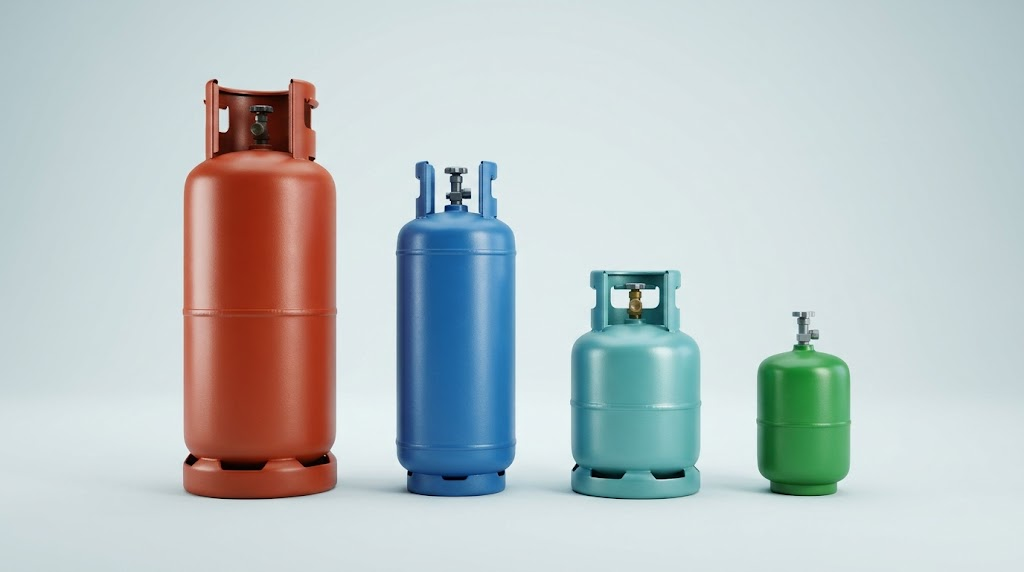
As refrigerant regulations 2026 take hold, equipment manufacturers have aligned behind three distinct lower-GWP alternatives to replace legacy R410A: Difluoromethane (R32), an HFC/HFO blend (R454B), and Propane (R290). Each balances thermodynamic performance, operating safety, and regulatory compliance differently:
| Refrigerant | GWP | ASHRAE Safety Class |
| R410A (baseline) | ~2,088 | A1 |
| R32 | 675 | A2L |
| R454B | 466 | A2L |
| R290 | ~0.02 | A3 |
R32 (GWP = 675 | Safety Class A2L)
R32 is a single-component refrigerant, simplifying charging, recycling, and servicing because it experiences zero temperature glide. Exhibiting excellent heat transfer performance, R32 allows system designs with lower overall refrigerant charges than R410A while yielding higher seasonal energy efficiency.
With a GWP of 675, R32 falls cleanly below the US EPA’s 700 GWP ceiling, making it a compliant long-term platform across North America. In the European Union, its GWP of 675 complies with the 2025 single-split regulations and splits over 12 kW through 2032, though the incoming 150 GWP bans will phase it out of smaller capacity categories between 2027 and 2029.
R454B (GWP = 466 | Safety Class A2L)
R454B is a zeotropic blend consisting of 68.9% R32 and 31.1% R1234yf (an HFO). With a GWP of 466, it easily clears the US 700 GWP threshold and offers thermodynamic properties closely matched to R410A, including similar operating discharge temperatures and pressures. This allows for straightforward engineering transitions from existing component architectures.
However, because it is a blend, it exhibits a small temperature glide, meaning technicians must observe proper liquid-phase charging procedures. Like R32, R454B is classified as ASHRAE A2L (lower flammability), requiring leak detection sensors and safety mitigation protocols in indoor occupied zones. In Europe, while its 466 GWP is lower than R32, it remains well above the 150 GWP threshold taking effect in 2027–2029 for residential classes.
R290 (GWP ≈ 0.02 | Safety Class A3)
R290 is high-purity propane, a natural refrigerant with a negligible GWP of approximately 0.02. It possesses outstanding thermodynamic efficiency, exceptional cycle performance, and high environmental safety.
Because it carries an ASHRAE A3 safety classification (higher flammability), stringent safety standards govern maximum charge limits, room volume ratios, and electrical isolation. As a result, R290 is currently deployed primarily in factory-sealed monobloc heat pumps, portable units, and self-contained commercial refrigeration where the refrigerant loop remains entirely outdoors or sealed at the factory. It represents the primary pathway for meeting Europe’s sub-150 GWP deadlines in 2027 and beyond.
Comprehensive Refrigerant Comparison
| Technical & Regulatory Parameter | Baseline: R410A | Contender: R32 | Contender: R454B | Contender: R290 |
| Chemical Composition | Blend (50% R32 / 50% R125) | Pure Component (100% R32) | Blend (68.9% R32 / 31.1% R1234yf) | Natural Pure Gas (Propane) |
| Global Warming Potential (GWP) | ~2,088 | 675 | 466 | ~0.02 |
| ASHRAE / ISO 817 Safety Class | A1 (Non-toxic, non-flammable) | A2L (Lower toxicity, lower flammability) | A2L (Lower toxicity, lower flammability) | A3 (Lower toxicity, higher flammability) |
| Relative Efficiency & Charge | Baseline reference | Higher efficiency; ~20–30% lower charge | Similar to R410A; higher seasonal efficiency | Superior efficiency; significantly lower charge |
| Temperature Glide | Negligible (<0.2 K) | 0 K (Pure substance, no glide) | ~1.5 K (Small glide, liquid charging required) | 0 K (Pure substance, no glide) |
| US Regulatory Horizon (AIM Act) | Phased out for new units (<700 GWP limit) | Fully compliant for split AC, HP, VRF, and chillers (<700 limit) | Fully compliant for split AC, HP, and commercial systems (<700 limit) | Compliant, but broad use restricted by A3 indoor charge limits |
| EU Regulatory Horizon (F-Gas) | Banned in small splits; bans VRF >12 kW in 2029 | Compliant for >12 kW splits to 2032; banned in small systems by 2027/2029 | Banned in small systems by 2027/2029 (<150 limit applies); compliant >12 kW to 2032 | Primary long-term solution for residential heat pumps/monoblocs (<150 limit) |
What This Means When You Source HVAC from China

As an overseas developer or distributor, sourcing equipment from Chinese manufacturing hubs like Foshan requires disciplined technical and supply-chain management. A procurement mistake made at the factory floor can result in customs seizures, project delays, or stranded field assets.
Use this operational checklist to audit your procurement process:
- 1. Match destination market regulatory limits (US <700 vs EU <150)
- 2. Audit OEM production lines (dedicated A2L safety systems)
- 3. Map long-term spare parts & field service availability
- 4. Account for ocean freight buffers & customs transit times
- 5. Secure factory compliance documentation (test reports, CE/SGS)
1. Map Refrigerant Platforms Directly to Destination Rules
Avoid assuming that an OEM’s export catalogue is universally compliant. While a factory may promote an economical R410A VRF system, shipping that container into the US after January 1, 2026, risks severe regulatory friction unless you fall strictly within documented build-permit exceptions.
If shipping to the EU, buying R32 splits under 12 kW today gives you a short operational runway before the 2029 sub-150 GWP ban takes effect, whereas sourcing R290 monobloc heat pumps ensures long-term viability past 2035.
2. Verify Factory Manufacturing Capabilities
Transitioning from non-flammable A1 refrigerants (like R410A) to A2L (R32, R454B) or A3 (R290) refrigerants requires dedicated factory engineering.
When vetting Chinese HVAC suppliers:
- Confirm the factory operates certified explosion-proof charging lines and automated helium leak detection stations.
- Inquire whether the manufacturer produces both R32 and alternative low-GWP systems in your required capacity classes.
- Ensure their internal electrical control systems incorporate certified leak mitigation logic, including integrated refrigerant sensor ports, mechanical ventilation relay triggers, and solenoid safety shut-off systems.
3. Evaluate the Spare Parts and Service Horizon for Legacy R410A
If you manage an existing base of R410A equipment in your local market, continued servicing remains legal under both US EPA and EU frameworks. However, you must manage your parts pipeline carefully:
- Inquire about the factory’s commitment window for R410A compressors, electronic expansion valves, and heat exchangers.
- As HFC production quotas drop — reaching 15% in the US by 2036 and zero in the EU by 2050 — virgin R410A prices will rise.
- Advise clients to inspect legacy equipment seals regularly to prevent costly recharges.
4. Build Ocean Freight and Lead Times into Regulatory Schedules
Lead times in international B2B HVAC procurement span months. A typical production cycle spans 30 to 45 days, followed by 20 to 40 days of ocean freight, plus customs clearance, inland drayage, and warehouse staging.
Ensure shipping schedules account for these timelines:
- Equipment arriving at a US port on December 28th that experiences a week-long customs delay risks entering past a critical year-end regulatory boundary.
- When specifying equipment near regulatory transition dates, request production runs that finish well ahead of enforcement deadlines.
5. Secure Verified Factory Documentation Before Shipment
Never release the final balance on an export order without securing and reviewing required technical documentation:
- Nameplate Verification: Confirm that outdoor condensing units and indoor air handlers display factory-stamped nameplates indicating the compliant refrigerant type, charge quantity (in kg and CO₂ equivalent), GWP, and flammability classifications.
- Testing Certifications: Request current factory test reports, ISO9001 quality audit documentation, and regional conformity documentation (such as CE declarations for Europe or ETL/UL 60335-2-40 compliance records for North America).
- Factory Declarations: For US VRF shipments navigating the transition windows, obtain signed manufacturer certificates documenting exact component production and shipping dates to satisfy US EPA import audits.
Conclusion: Future-Proof Your Orders with George Air Condition
The global R410A phase down is an industry reality. Navigating these transitions requires balancing regulatory compliance with technical performance and commercial competitiveness. For the vast majority of international markets outside the most restrictive upcoming EU categories, R32 represents the most balanced, energy-efficient, and mature low-GWP solution available today.
Future-proofing your equipment sourcing means partnering with an established supplier capable of navigating shifting global standards. Based in Foshan, China, George Air Condition has delivered comprehensive HVAC equipment export solutions for over 16 years. Holding CE, SGS, and ISO9001 certifications, George supplies high-efficiency VRF systems, central air conditioning, commercial heat pumps, ERV ventilation units, and chillers to contractors, developers, and distributors worldwide.
To help our global partners transition smoothly, George provides advanced GREE R32 eco-friendly systems. These systems deliver high seasonal energy performance, zero ozone depletion potential, and a 68% lower GWP than legacy R410A systems, all backed by comprehensive factory warranties and full technical documentation.
Whether you are designing a high-capacity commercial development, outfitting a residential multi-family project, or securing your distribution warehouse for next season, our technical engineering team can advise on market-specific refrigerant compliance and equipment sizing.
Send us your project drawings, equipment schedules, or bill of quantities today to receive a comprehensive technical compliance review and a free, factory-direct quotation.
Sources
- US Environmental Protection Agency (US EPA): Technology Transitions Program under the American Innovation and Manufacturing (AIM) Act of 2020. Regulations, product bans, and reconsideration rulings available via epa.gov/hfcs.
- European Union: Regulation (EU) 2024/573 of the European Parliament and of the Council on fluorinated greenhouse gases (repealing Regulation (EC) No 517/2014), in force March 11, 2024. Available via EUR-Lex.
- International Energy Agency (IEA): The Future of Cooling: Opportunities for energy-efficient air conditioning and Space Cooling Tracking Report. Available via iea.org.