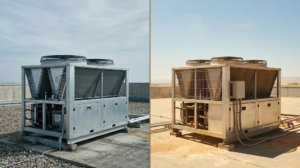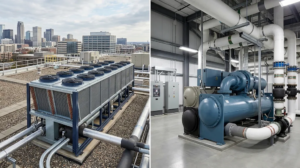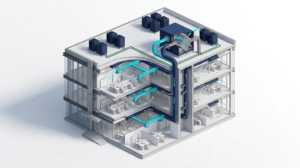
The decision is becoming more important as cooling demand rises. According to the International Energy Agency (IEA), global electricity demand for space cooling has grown by 50% since 2015, reaching approximately 2,900 terawatt-hours (TWh). For building owners, this means that an inefficient central cooling decision can lock in substantial energy costs well beyond the initial construction budget.
The short answer is:
- Air-cooled chillers are usually easier to install and avoid cooling-tower water consumption. They are often attractive for projects with limited plant-room space, moderate runtimes, restricted water availability, or a preference for simpler infrastructure.
- Water-cooled chillers often achieve higher efficiency in larger, longer-running applications, but only after the cooling tower, condenser-water pumps, water treatment, and additional maintenance are included in the evaluation.
This guide explains how to compare the two options using system-level efficiency and lifecycle cost—not catalogue headlines alone.
Quick Comparison: Air-Cooled vs Water-Cooled Chillers
| Decision factor | Air-cooled chiller | Water-cooled chiller |
| Heat rejection | Air-cooled condenser and fans | Water-cooled condenser, cooling tower and condenser-water pump |
| Typical efficiency potential | Generally lower at high ambient temperatures; strong options are available with VFDs and modern controls | Often higher, especially in large or long-runtime plants; actual result depends on the complete plant |
| Auxiliary equipment | Condenser fans and chilled-water pumps | Condenser fans at the tower, condenser-water pumps and chilled-water pumps |
| Cooling-tower water use | None for a conventional air-cooled condenser; adiabatic variants are an exception | Yes: evaporation, drift and blowdown require make-up water |
| Plant-room requirement | Usually limited; equipment is commonly installed outdoors | Usually requires an indoor chiller plant plus an outdoor cooling-tower location |
| Installation complexity | Fewer major water-side components | More piping, pumps, controls, water treatment and commissioning |
| Maintenance focus | Condenser coils, fans, refrigerant circuit and electrical components | Chiller plus tower, condenser-water loop, water chemistry and biological control |
| Performance constraint | Outdoor dry-bulb temperature, coil condition and airflow | Outdoor wet-bulb temperature, tower approach, flow rates and water-side fouling |
| Upfront infrastructure | Often lower and simpler | Often higher because of the tower, pumps, piping and plant room |
| Best-fit projects | Retrofits, distributed projects, water-constrained sites and many small-to-medium installations | Large buildings, campuses, hospitals, hotels, process loads and long-runtime central plants |
Important: this table describes common design tendencies, not a universal ranking. A high-efficiency air-cooled machine can outperform a poorly designed water-cooled plant. Always compare project-specific selections under the same boundary conditions.
How Each System Rejects Heat
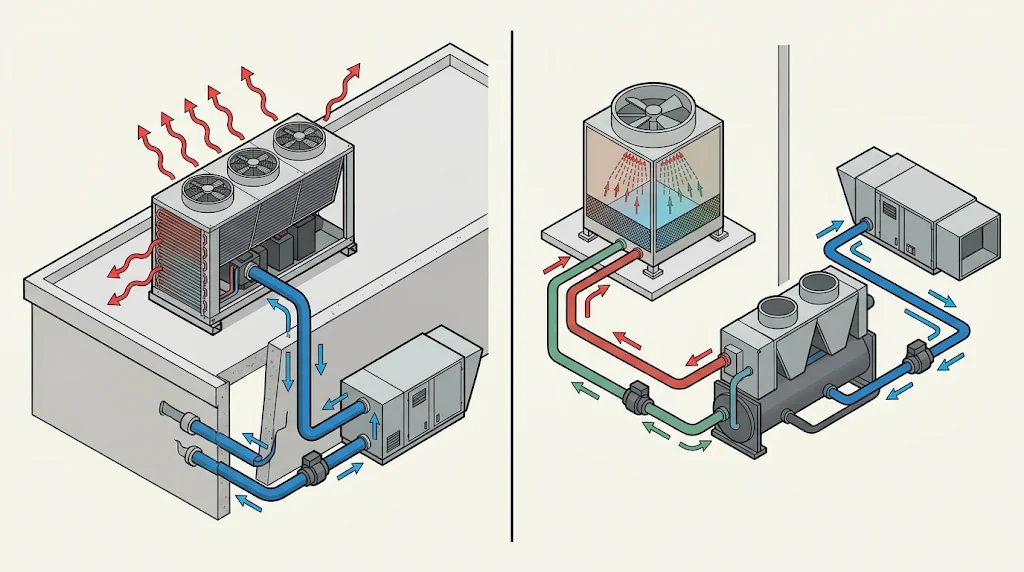
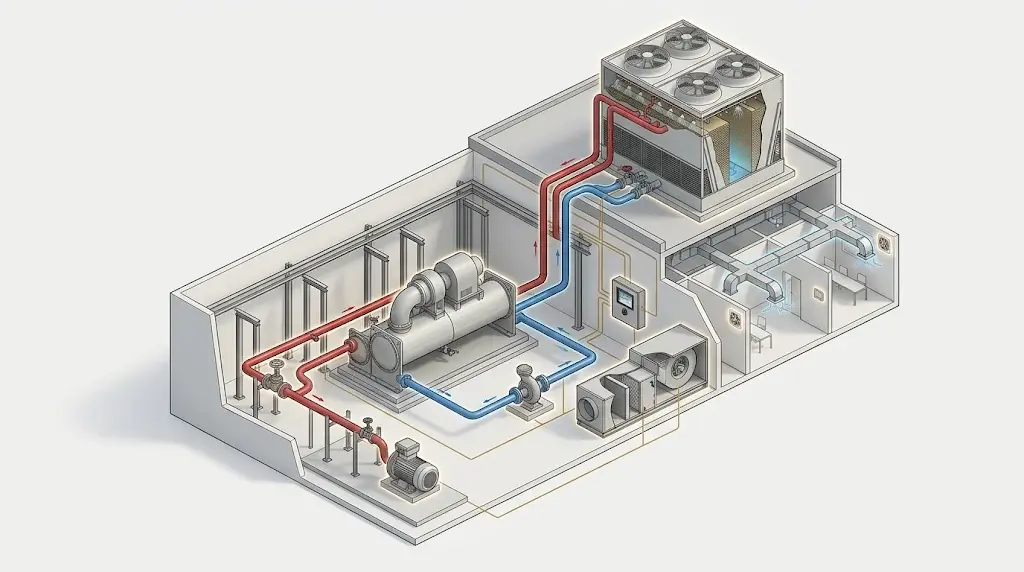
Both systems produce chilled water for air-handling units, fan coils, or process equipment. Their main difference is how they reject heat from the refrigeration cycle.
Air-cooled chillers: heat rejection to outdoor air
An air-cooled chiller uses fans to move outdoor air across the condenser coil. Because the condenser rejects heat to air, its performance is closely related to the outdoor dry-bulb temperature. On very hot days, the temperature difference available for heat rejection becomes less favorable, increasing compressor work. Blocked airflow, recirculated hot air, and dirty coils can create additional penalties.
The major advantage is infrastructure simplicity. A conventional air-cooled system does not need a cooling tower, condenser-water pump, or open condenser-water treatment loop. This can reduce coordination between mechanical, plumbing, structural, and water-treatment trades.
However, “air-cooled” does not mean “pump-free.” Comfort-cooling systems still normally need chilled-water pumps to distribute cooling to AHUs or fan coils. Those pumps belong in any fair system-energy comparison.
Water-cooled chillers: heat rejection through a cooling tower
A water-cooled chiller transfers heat to condenser water. The water then flows to a cooling tower, where heat is rejected mainly through evaporation. Cooling-tower performance is linked to the outdoor wet-bulb temperature, tower design, airflow, water flow, and approach temperature.
This heat-rejection method often allows lower condensing temperatures and better chiller efficiency, particularly in large systems with long annual operating hours. But the chiller nameplate does not include every energy input required to make the plant work. Condenser-water pumps and tower fans must be counted alongside the compressor and chilled-water pumps.
George supplies both configurations within its commercial and industrial chiller range, including air-cooled screw, water-cooled screw, and centrifugal options. The correct choice should therefore begin with the project profile rather than a predetermined preference for one condenser type.
Efficiency: Compare the Whole Plant, Not Just the Chiller
Start with the same efficiency metrics and rating conditions
A supplier quotation may contain COP, EER, kW/ton, IPLV, or NPLV. These values are useful only when you understand what they measure.
- COP is cooling output divided by power input under a stated condition. Higher is better.
- kW/ton is electrical input per refrigeration ton. Lower is better.
- EER expresses cooling output in Btu/h per watt of input under its specified rating conditions. Higher is better.
- IPLV is a standardized part-load rating based on weighted operating points.
- NPLV applies part-load calculations to non-standard application conditions.
Do not compare one product’s full-load COP with another product’s IPLV. Do not compare values based on different chilled-water temperatures, condenser-water temperatures, fouling allowances, or test standards without normalization.
The AHRI Standard 550/590 IPLV weighting assigns 1% to 100% load, 42% to 75% load, 45% to 50% load, and 12% to 25% load. In other words, 87% of the standardized weighting sits at the 75% and 50% points. This is why part-load performance deserves serious attention.
But the weighting is a common rating convention—not a measurement of your building. A data center, hospital, hotel, office, and plastics factory can have very different load profiles. For a specific project, request performance at the actual chilled-water and condenser conditions and use an hourly energy model where the investment justifies it.
Use system kW/ton for an apples-to-apples comparison
A chiller-only comparison can overstate the advantage of a water-cooled machine because it may exclude the cooling tower and condenser-water pump. A useful system boundary should include:
For air-cooled systems:
- Chiller compressors
- Condenser fans
- Chilled-water pumps
- Relevant controls and auxiliary loads
For water-cooled systems:
- Chiller compressors
- Cooling-tower fans
- Condenser-water pumps
- Chilled-water pumps
- Relevant controls and auxiliary loads
The basic energy calculation is:
Annual energy use (kWh) = Average cooling load (RT) × System efficiency (kW/RT) × Annual operating hours
For variable loads, perform the calculation across representative load bins or use hourly simulation rather than assuming one average condition for the entire year.
Do not overlook ventilation and envelope loads
The most efficient chiller is the one that does not need to serve an avoidable load. Solar gains, infiltration, lighting, equipment, and outdoor-air requirements all affect the required plant capacity. Ventilation should be designed for indoor air quality without creating unnecessary cooling and dehumidification demand.
Where the application is suitable, energy-recovery ventilation can precondition incoming outdoor air. George’s commercial ERV ventilation solutions can be evaluated as part of this wider load-reduction strategy. ERV does not replace a chiller, but it can reduce the load that the chilled-water plant must handle under appropriate climate and airflow conditions.
Water Use, Treatment and Health-Safety Responsibilities
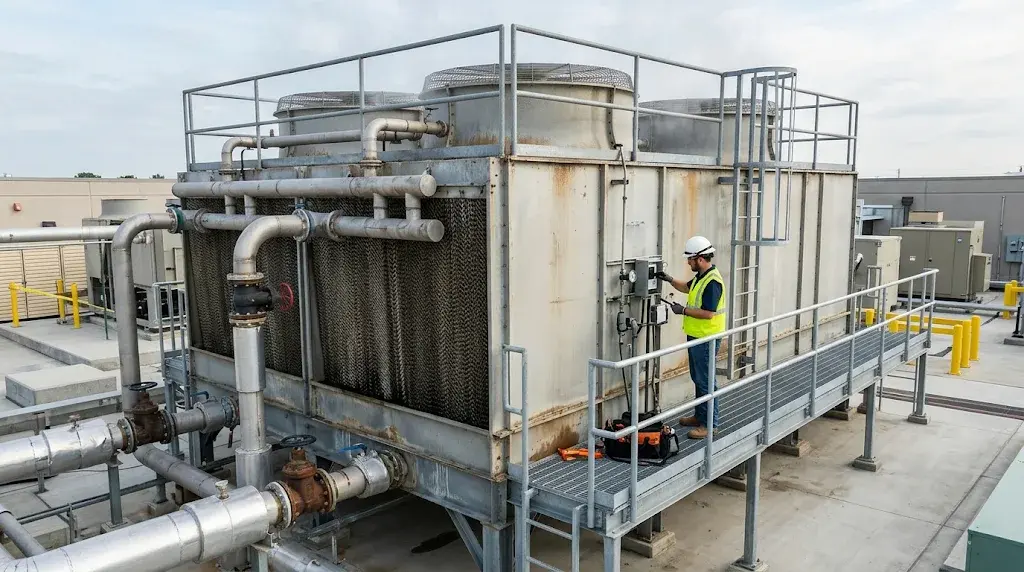
Water consumption is one of the clearest differences between conventional air-cooled and water-cooled systems.
A water-cooled plant loses water through:
- Evaporation, which is central to the cooling tower’s heat-rejection process.
- Drift, meaning small water droplets carried out of the tower by airflow.
- Blowdown, which removes concentrated dissolved solids and helps control scaling, corrosion, and biological growth.
The US EPA WaterSense guidance for mechanical systems states that building and equipment heating and cooling can account for as much as 30% of total water use in some facilities. That figure covers mechanical heating and cooling systems broadly, not cooling towers alone, but it demonstrates why water should be part of the procurement calculation rather than an afterthought.
For a water-cooled option, ask the design team to estimate annual make-up water using project-specific load, climate, tower cycles of concentration, drift control, and blowdown assumptions. Include sewer charges and water-treatment chemicals where applicable. Alternative water sources may reduce potable-water demand, but their quality and local acceptance must be verified.
Water management is also a health-safety issue. The US Centers for Disease Control and Prevention (CDC) specifically identifies cooling towers as devices that should have a water management program even when the building itself would not otherwise require one. A responsible water-cooled design therefore includes access for cleaning, monitoring, treatment, documentation, and control of Legionella risk in accordance with local requirements and applicable standards.
A conventional air-cooled chiller avoids this open cooling-tower loop. That can be a decisive advantage where skilled water-treatment support is unavailable, water is expensive or unreliable, or local restrictions make tower operation difficult. Adiabatic air-cooled equipment is a separate case because it can use water to improve heat rejection and should be assessed accordingly.
Installation, Space, Maintenance and Reliability
Air-cooled: simpler does not mean effortless
Air-cooled chillers are commonly installed on roofs, podiums, or ground-level equipment yards. This can free indoor plant-room space and shorten mechanical coordination. It can also simplify phased expansion in some projects.
Before selecting this route, verify:
- Roof or foundation structural capacity
- Equipment rigging and crane access
- Clearances for condenser airflow and maintenance
- Prevention of hot-air recirculation between multiple units
- Wind, corrosion, dust, and coastal exposure
- Noise transmission to occupied spaces and neighboring properties
- Electrical service and starting or VFD requirements
Outdoor exposure also makes coil condition and environmental protection important. A dusty site may require more frequent cleaning; a coastal site may require suitable corrosion protection.
Water-cooled: more infrastructure, more optimization opportunities
Water-cooled plants require space for chillers, pumps, piping, water treatment, and often a separate cooling-tower location. They need more commissioning coordination, including flow verification, tower control, water treatment, and plant sequencing.
In return, a well-designed central plant can offer excellent control and serviceability. Multiple chillers can be staged to match load, variable-speed pumps and tower fans can reduce auxiliary energy, and condenser-water reset can improve performance when conditions allow. Redundancy can be engineered at the chiller, pump, and tower levels rather than relying on a single packaged asset.
Reliability should be evaluated at system level. Air-cooled systems have fewer cooling-water components, but multiple outdoor fans and coils still require maintenance. Water-cooled systems add towers and water treatment, but the main chillers are usually sheltered indoors. Neither configuration is automatically more reliable; design quality, accessibility, controls, water management, and preventive maintenance determine the outcome.
For large hospitality projects, these infrastructure decisions should be coordinated with guest-room zoning, public-area loads, ventilation, and operating schedules. Our hotel HVAC design and equipment guide explains where central chillers and alternative systems typically fit within a complete hotel solution.
Lifecycle Cost: A Worked Example
Why the lowest purchase price can be the most expensive choice
Singapore’s National Environment Agency provides a useful chiller lifecycle example in its Air-Conditioning and Mechanical Ventilation Systems guide. The guide compares three 600 RT options using 10 hours per day, 300 days per year, an electricity tariff of $0.20/kWh, and 2% annual electricity-price escalation.
The highest-efficiency option in the example costs 420,000** and operates at **0.50 kW/RT**. The lower-efficiency option costs **390,000 and operates at 0.65 kW/RT. Although the efficient machine costs 30,000 more initially, its published 10-year lifecycle cost is **2,390,950**, compared with 2,952,235** for the lower-efficiency option—a difference of approximately **561,000 under the guide’s assumptions.
This example is not an air-cooled-versus-water-cooled comparison, and it should not be used as a savings promise. Its lesson is broader: a modest efficiency difference can outweigh a purchase-price difference when a chiller operates for thousands of hours.
Illustrative air-cooled vs water-cooled energy calculation
The following simplified example shows how to structure a project comparison. These are illustrative assumptions, not universal performance values:
- Peak installed load: 500 RT
- Average operating load: 60% of peak, or 300 RT
- Annual operation: 3,000 hours
- Air-cooled system efficiency: 1.05 kW/RT, including the defined auxiliaries
- Water-cooled plant efficiency: 0.70 kW/RT, including tower and pumps
- Blended electricity price: $0.15/kWh
| Calculation | Air-cooled system | Water-cooled system |
| Average cooling load | 300 RT | 300 RT |
| Annual energy use | 300 × 1.05 × 3,000 = 945,000 kWh | 300 × 0.70 × 3,000 = 630,000 kWh |
| Annual electricity cost | $141,750 | $94,500 |
| Illustrative difference | — | 315,000 kWh and $47,250 per year |
This is only the energy line of the business case. A complete comparison must then add:
- Installed equipment and construction cost
- Cooling-tower make-up water and sewer charges
- Water treatment and tower maintenance
- Demand charges and time-of-use tariffs
- Preventive maintenance and expected repairs
- Controls integration and commissioning
- Replacement schedules and equipment life
- Downtime tolerance and redundancy requirements
- Financing, discount rate, and analysis period
A simple payback can screen the options:
Simple payback = Additional installed cost ÷ Annual net operating savings
Use net savings after water, treatment, and maintenance differences. For a major central plant, move beyond simple payback and use a discounted lifecycle-cost model with sensitivity tests for electricity price, water price, operating hours, and equipment degradation.
Which Chiller Fits Your Project?
Air-cooled may be the stronger choice when:
- The project has limited indoor plant-room space.
- Cooling-tower water use is restricted, expensive, or difficult to manage.
- Annual operating hours are moderate, reducing the value of a plant-efficiency premium.
- A retrofit needs to minimize new pumps, piping, and tower infrastructure.
- Roof or outdoor installation is structurally and acoustically feasible.
- The owner prefers simpler water-side infrastructure and has limited access to water-treatment expertise.
Water-cooled may be the stronger choice when:
- The building or process has a large cooling load and long annual runtime.
- Electricity cost and peak demand make efficiency especially valuable.
- A central plant, cooling-tower location, and maintenance access are available.
- The project needs centralized redundancy, plant sequencing, or future capacity planning.
- Water availability, treatment, monitoring, and health-safety responsibilities can be managed professionally.
- Lifecycle cost matters more than the lowest initial equipment price.
Avoid using a single tonnage cutoff as the decision rule. Climate, utility prices, load profile, existing infrastructure, and owner capabilities can move the economic boundary in either direction.
When VRF May Be the Better Alternative
Not every commercial building needs a chilled-water plant. For projects with many independently controlled zones, variable occupancy, and limited central-plant space, a VRF system may offer a better balance of zoning and installation flexibility.
VRF is not a direct substitute in every application. Large process loads, centralized plants, certain high-capacity facilities, and projects requiring strict chilled-water conditions may favor chillers. Conversely, a building that mainly needs independent room-by-room control may not benefit from central chilled-water infrastructure.
Our VRF systems buyer’s guide explains the technology, costs, benefits, and limitations in detail. If VRF remains on the shortlist, the next step is a room-by-room load assessment and a manufacturer-specific review using our commercial VRF sizing guide. The best answer may also be a hybrid: central cooling for large common areas and VRF for selected occupied zones.
Procurement Checklist: What to Request from Every Bidder
To compare air-cooled and water-cooled quotations fairly, request the following information in one consistent schedule:
- Design basis: project location, weather conditions, peak load, load profile, operating hours, and future expansion assumptions.
- Water conditions: chilled-water supply/return temperatures and flow; condenser-water temperatures and flow for water-cooled options.
- Rated performance: capacity, full-load efficiency, IPLV and project-specific NPLV where relevant, with the rating standard clearly identified.
- System boundary: a list showing whether fans, chilled-water pumps, condenser-water pumps, tower fans, controls, and other auxiliaries are included.
- Part-load data: performance at meaningful load points and ambient conditions, not just the design-day maximum.
- Electrical requirements: voltage, frequency, phase, starting current or VFD data, maximum demand, and recommended protection.
- Physical requirements: dimensions, operating weight, service clearances, rigging route, structural loads, and airflow or tower-placement requirements.
- Water-side scope: cooling tower, pumps, piping, water treatment, controls, expected make-up water, and commissioning responsibilities.
- Controls: staging logic, variable-speed control, condenser-water or chilled-water reset options, alarm history, and BACnet/Modbus integration where required.
- Acoustics and environment: sound data, vibration isolation, corrosion protection, ambient operating envelope, and low-temperature safeguards where applicable.
- Refrigerant and compliance: refrigerant type, charge, GWP, safety classification, local code compliance, and destination-market documentation. Our R410A phase-down guide explains why refrigerant requirements should be checked before ordering.
- Commercial scope: warranty, spare parts, lead time, documentation, training, technical support, exclusions, and the exact boundary between equipment supply and installation.
If two bids do not use the same scope and operating assumptions, they are not yet comparable.
FAQ
Which is more energy efficient: an air-cooled or water-cooled chiller?
Water-cooled chillers often have higher rated efficiency, especially in large central plants. However, the correct comparison is system-level annual energy use, including tower fans and condenser-water pumps. A well-selected air-cooled system can be the better economic choice for shorter runtimes or where water-cooled infrastructure is expensive.
Does an air-cooled chiller use water?
A conventional air-cooled condenser does not consume cooling-tower water. The system still normally uses a closed chilled-water loop to serve AHUs or fan coils. Adiabatic air-cooled equipment can also use water during certain operating conditions, so check the exact model rather than relying on the category name.
Is a water-cooled chiller always cheaper over its lifetime?
No. It may produce lower energy costs in long-runtime applications, but the savings must cover the additional plant infrastructure, water, treatment, and maintenance. Short operating hours, low electricity prices, high water costs, or poor plant design can reduce or eliminate the advantage.
Should I compare COP, IPLV, or kW/ton?
Use the metric consistently and check its rating conditions. Full-load COP or kW/ton helps at the design point; IPLV provides a standardized part-load comparison; project-specific NPLV or hourly simulation is more relevant when actual conditions differ from the standard. For plant economics, include auxiliary energy rather than looking at the compressor alone.
Can I replace an existing water-cooled chiller with an air-cooled model?
Often, yes, but it is not a like-for-like swap. The project must review outdoor space, structural capacity, airflow, acoustics, electrical service, chilled-water connections, controls, capacity at design ambient temperature, and what should happen to the existing tower and condenser-water system. A site assessment is essential.
What information should I send for a chiller recommendation and quotation?
Provide the project country and city, building type, drawings, peak and typical loads, operating schedule, chilled-water temperatures, electrical supply, preferred refrigerant or local compliance requirements, water availability, and any space or noise restrictions. Electricity and water tariffs also help the team build a more meaningful lifecycle comparison.
Conclusion: Select the System, Not Just the Chiller
The choice between air-cooled and water-cooled chillers should be made at system level. Air-cooled equipment offers simpler heat-rejection infrastructure and avoids conventional cooling-tower water use. Water-cooled equipment can deliver strong efficiency in larger, longer-running plants, but its tower, pumps, water treatment, and maintenance must be included in the calculation.
A reliable procurement decision combines four elements: project-specific load data, normalized efficiency ratings, complete utility costs, and a realistic lifecycle model. This approach prevents both common mistakes—buying the cheapest machine and buying the highest catalogue efficiency without checking the plant around it.
George Air Condition provides equipment selection and coordination for commercial HVAC solutions, including air-cooled screw, water-cooled screw, and centrifugal chiller options. Send us your drawings, cooling load, operating schedule, and project location to request a system recommendation and a factory-direct quotation. The more complete the project inputs, the more useful the technical and lifecycle comparison will be.
Authoritative Sources
- International Energy Agency — Cooling a hotter world: El Niño meets strong growth in global electricity demand, July 10, 2026. Global space-cooling electricity demand and growth.
- Air-Conditioning, Heating, and Refrigeration Institute — AHRI Standard 550/590 (I-P), 2020 with Addendum 1. Chiller rating conditions and part-load methodology.
- US Environmental Protection Agency, WaterSense at Work — Section 6.1: Introduction to Mechanical Systems. Mechanical-system water use and cooling-tower water management.
- US Centers for Disease Control and Prevention — Identify Buildings with Increased Legionella Risk. Cooling towers and water management programs.
- Singapore National Environment Agency — Air-Conditioning and Mechanical Ventilation Systems. Chiller efficiency and lifecycle-cost example.
Technical note: Performance and cost examples in this article are for procurement education, not a guarantee of project savings. Final equipment selection should be checked by the project engineer against local codes, site conditions, utility tariffs, and manufacturer data.