Key Takeaways
- Multiple inventors built our modern HVAC technology through many separate breakthroughs over time.
- Alice Parker patented a natural gas furnace in 1919 that laid the foundation for central heating.
- Frederick McKinley Jones invented portable cooling units for trucks in 1938 to protect food and medicine.
- Willis Carrier built the first modern electric air conditioner in 1902 to control humidity levels accurately.
Scientific Foundations of Thermodynamics
Carnot and Joule on Thermal Energy
Modern indoor climate control relies on basic physical laws. Early scientists established how thermal energy converts into mechanical work. The First Law of Thermodynamics proves energy cannot be destroyed. For example, a gas furnace converts 100 units of fuel energy into useful indoor heat or flue losses. Engineers also apply the Ideal Gas Law to estimate density changes, airflow rates, and fan performance within building ducts.
James Prescott Joule conducted detailed experiments on energy conversion. His paddle-wheel apparatus used falling weights to stir fluids, causing measurable temperature increases of 0.5–2°F (0.28–1.1°C). His fluid friction tests yielded a mechanical equivalent of 770 foot-pounds per British thermal unit (Btu). Joule demonstrated that mechanical work produces reliable heat quantities. His measurements gave later inventors the mathematical basis for mechanical cooling systems.
Lord Kelvin and Thermal Physics
Lord Kelvin expanded thermodynamic theory to define physical temperature limits. In 1848, Kelvin derived absolute zero as -273 °C (-459.4 °F) by using an ideal gas thermal expansion coefficient of 0.00366 per degree Celsius. His absolute scale provided accurate baseline measurements for thermal dynamics. The Second Law of Thermodynamics dictates that heat flows spontaneously from hotter bodies to colder bodies. Air conditioners must expend work to reverse this natural flow.
In 1852, Kelvin conceptualized an air-source heat pump named the heat multiplier. He clarified that refrigeration systems move thermal energy from indoor spaces to outdoors rather than creating coldness. His calculations indicated this system could match direct heating output using merely 3% of the energy input. His foundational theories directly guided modern refrigeration development and inspired early commercial cooling companies.
Pioneers in Central Heating Systems
Alice Parker and Natural Gas Heating
Alice H. Parker transformed residential climate control in the early twentieth century. She received US Patent #1,325,905 on December 23, 1919, for a gas-fired furnace design. Her mechanism drew cool indoor air directly into a central heat exchanger. Natural gas burned inside the unit to warm the air cleanly. The furnace then pushed warm air through air ducts into separate rooms of a building.
Her patent introduced the practical foundation for zoned central heating. Parker built her system with multiple burners that operated independently. Household occupants could alter airflow and control temperature levels in individual rooms for the first time. This system replaced single floor registers and eliminated dirty wood or coal fuels. Although manufacturers never mass-produced her unit, her concept laid the groundwork for modern zonal heating systems.
Radiators and Steam Heating Innovations
Steam distribution provided powerful heat for multi-story buildings. Early innovators created unique mechanical components to improve system safety and heating efficiency:
- Stephen Gold invented an automatic safety valve in 1854 to lower steam boiler pressures safely.
- Nelson Bundy patented the cast iron Bundy Loop radiator in 1872, using oval looping tubes to increase surface area.
- A 1935 National Bureau of Standards report showed aluminum-bronze paint reduced radiator heat output by about 20%.
- Radiator covers with solid tops reduced total heat output by up to 40%.
Inventor David Crosthwait Jr. advanced commercial steam heating and indoor ventilation design. He patented an improved boiler system, modern thermostat controls, and specialized return pumps. His design for a differential vacuum pump received U.S. Patent No. 1,727,965. This device moved steam and condensate through large building pipes efficiently. His central heating and ventilation techniques provided reliable climate control for complex facilities, including Radio City Music Hall and Rockefeller Center.
Who Invented Air Conditioning? Early Mechanical Cooling
John Gorrie and Ice-Making Machines
When tracing the origins of modern climate control, Dr. John Gorrie’s work in 1842 is a critical starting point. In 1820, Michael Faraday discovered that compressing and expanding gas could chill air. Dr. John Gorrie expanded this scientific concept in 1842. He built a mechanical system that compressed gas, cooled it through radiating coils, and expanded it to lower air temperatures significantly.
Gorrie used his device to cool hospital rooms for yellow fever and malaria patients in Florida. Steam powered two compressor pumps that circulated air through pipes around water containers to form ice. Gorrie received U.S. Patent No. 8080 on May 6, 1851, for his ice-making machine. The Smithsonian Institution preserves his original patent model today.
Frederick McKinley Jones and Mobile AC
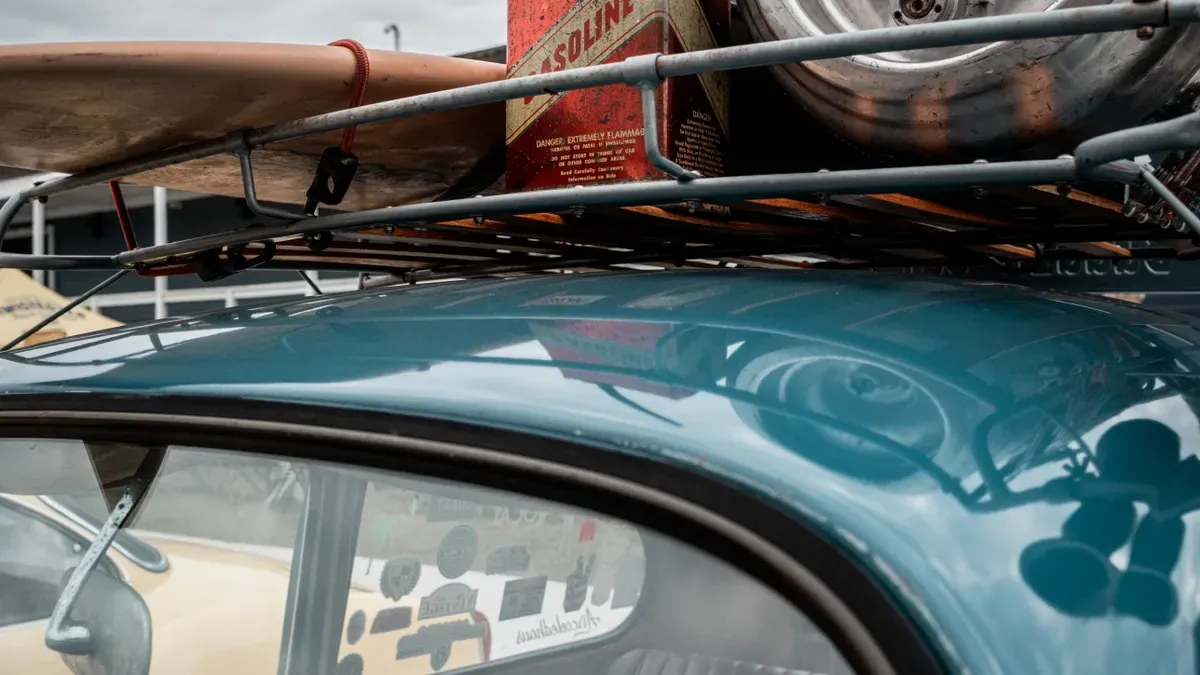
Mechanical cooling moved from static buildings to vehicles during the early twentieth century. Most articles about the invention of the air conditioner overlook mobile refrigeration. Frederick McKinley Jones built a practical portable cooling system in 1938.
By 1938, Jones had developed a working prototype using a small internal-combustion engine to drive a compressor and condenser assembly. The design incorporated vibration isolation through flexible mountings and balanced rotating parts, addressing the core problem that had rendered earlier systems unreliable on rough roads. In field tests during 1940, the Model C demonstrated unprecedented reliability, sustaining uniform sub-40 °F conditions over continuous operation.
Jones refined his transport systems for Thermo King across three early models:
- Model A (1939): Mounted under semi-trucks and passed refrigerant tubing to trailers.
- Model B (1940): Reduced system weight but lacked intensive durability.
- Model C (1941): Used a front-mounted 700 lbs unitary body resistant to road vibration.
These portable cooling units preserved food, blood plasma, and medicine during World War II. The U.S. military also used his systems to cool field hospitals and airplane cockpits. Anyone examining the history of air conditioning must credit his transport inventions for modern mobile cooling.
Willis Carrier and Modern HVAC Systems
Carrier and Modern Electrical AC
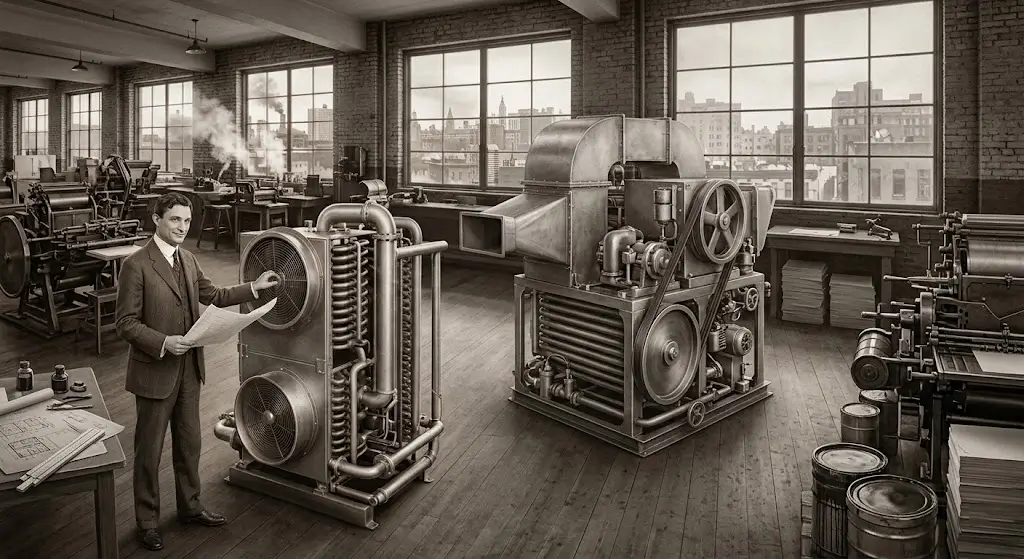
Willis Carrier solved a major humidity problem at a Brooklyn printing plant in 1902. His work created the framework for modern electrical systems.
Genius can strike anywhere. For Willis Carrier, it was a foggy Pittsburgh train platform in 1902. Carrier stared through the mist and realized that he could dry air by passing it through water to create fog. Doing so would make it possible to manufacture air with specific amounts of moisture in it. Within a year, he completed his invention to control humidity – the fundamental building block for modern air conditioning.
Interestingly, Carrier didn’t coin the term itself. Stuart W. Cramer, a textile engineer, first used “air conditioning” in 1906 to describe adding moisture to the air in his factory. Carrier recognized the brilliance of the phrase and later adopted it for his own company.
Discussions about the creator of modern AC often point to Carrier’s core scientific breakthroughs. He secured a patent for his air-treating apparatus in 1906. He published the Rational Psychrometric Formulae in 1911 to bring mathematical precision to climate design.
| Core Invention | Year / Period | Principle Established |
|---|---|---|
| Apparatus for Treating Air | 1902 | Combined cooling, dehumidification, and air circulation by passing air through cooling coils. |
| Psychrometric Chart | 1911 | Defined relationships between temperature and humidity for precise system design. |
Commercialization of Modern Climate Control
Carrier co-founded the Carrier Engineering Corporation in 1915 to commercialize his systems. He patented a low-pressure centrifugal refrigeration machine in 1921. This compact unit used a safer refrigerant called dielene. Detroit’s J.L. Hudson Department Store installed the unit in 1924 to boost summer retail sales.
The Rivoli Theater in New York installed Carrier’s machine in 1925. Summer ticket sales increased by over $100,000, which covered the installation cost. Carrier expanded his technology into new sectors over the following decades:
- Public venues like Madison Square Garden in 1925.
- Skyscraper architecture in the Milam Building in 1928.
- Maritime transport on the M.V. Victoria in 1931.
- Public transit inside an air-conditioned city bus in 1946.
American prosperity fueled rapid adoption after World War II. Manufacturers sold 1 million air conditioning units in 1953 alone, driving population growth across warmer regions.
However, this massive proliferation brought unforeseen environmental challenges. Early air conditioners relied on refrigerants like toxic ammonia or early CFCs (Freon), which were later discovered to severely damage the ozone layer and contribute to global warming. Today, the HVAC industry is undergoing another historic revolution, shifting away from these harmful chemicals toward eco-friendly refrigerants and highly efficient smart systems.
The journey of climate control spans multiple landmark breakthroughs. Dr. John Gorrie initiated mechanical refrigeration with his early ice-making experiments in 1842. Alice Parker advanced indoor heating by patenting her natural gas furnace concept in 1919. Willis Carrier then synthesized these principles into the first modern electrical system. Those exploring how air conditioning was invented often discover that modern HVAC technology relies on many contributors rather than a single creator.
From Gorrie’s hospital ice-maker to Carrier’s theater cooling, these early milestones laid the groundwork for today’s commercial HVAC engineering. Modern facilities no longer just blow cold air; they rely on advanced central air conditioning and precise VRF (Variable Refrigerant Flow) systems with automated airflow controls. Ultimately, the quest for indoor comfort evolved into a sophisticated science of energy efficiency and smart building management.
FAQ
Who invented air conditioning?
Willis Carrier designed the first modern electrical air conditioning system in 1902 to solve humidity issues at a printing plant. However, earlier inventors like Dr. John Gorrie created mechanical cooling devices as early as 1842. Modern HVAC systems resulted from cumulative breakthroughs by many pioneers.
What was Alice Parker’s contribution to heating systems?
Alice Parker received a patent in 1919 for a natural gas furnace design. Her system drew cool air into a heat exchanger and distributed warm air through ducts. This concept laid the foundation for modern zoned central heating systems.
How did Frederick McKinley Jones advance cooling technology?
Frederick McKinley Jones developed a portable refrigeration system in 1938 for long-distance transport trucks. His durable design survived road vibrations and preserved fresh food, blood plasma, and medicine. His work led to the founding of Thermo King and enabled modern mobile refrigeration.
Why was David Crosthwait important to modern HVAC design?
David Crosthwait patented essential steam heating components, modern thermostats, and an innovative differential vacuum pump. His engineering work improved steam distribution and ventilation control in large facilities. He successfully designed the heating and climate control systems for Rockefeller Center and Radio City Music Hall.